
The Red Sea : A Spiritual Psychology of Change according to the Midrash
Have you ever felt like life was forcing you to turn back ? That, just when you thought you were moving toward the light, you suddenly found yourself facing a dead end, stuck between your past fears and an impassable obstacle ?
The crossing of the Red Sea is not just a historical narrative ; it is a roadmap for every soul seeking to break its inner chains. Through the lens of spiritual psychology and the Midrash, let’s discover how to transform our dead ends into paths of freedom.
1. The Mental Prison : Why the detour ?
A question arises : why did God lead the Hebrews to the Red Sea, thereby lengthening the path ?
The Midrash Shemot Rabbah (20:11) explains that God was not looking for the shortest path, but the most transformative one.
This is the drama of mental slavery : we become accustomed to our limits. Like that man who stayed 63 years in prison and refused freedom out of fear of the unknown, we eventually believe that our blockages are our identity.
Egypt, in Hebrew Mitzrayim, is often interpreted by the masters as coming from the word metzarim, the narrownesses. Egypt is therefore not just a geographical place ; it is a limited state of consciousness.
The significance of the crossing of the Red Sea lies precisely in this divine therapy : God places the people in front of an apparent impossibility in order to break the mental frameworks of slavery.
The sea had to split not only in nature, but in the mind.
2. The “Divine GPS” and the meaning of trials
The biblical text mentions a return toward Pi Ha’Hiroth — literally “the mouth of freedom”.
The Midrash emphasizes that this place symbolizes the last illusions of the slave. Sometimes, to move forward, one must face what terrifies us most.
The scene is striking : behind them the Egyptian army, in front of them the sea. All human logic concludes that the situation is hopeless.
But it is precisely in this moment that the transformation begins.
Rabbinic tradition reports that the sea only opened after the first step into the water. The gesture of Nahshon ben Amminadab symbolizes this decisive moment : change begins when man acts with trust beyond his rational calculation.
In the spiritual psychology of the Midrash, the miracle does not always precede action. It is sometimes its consequence.
3. The Twelve Paths : Every soul has its crossing
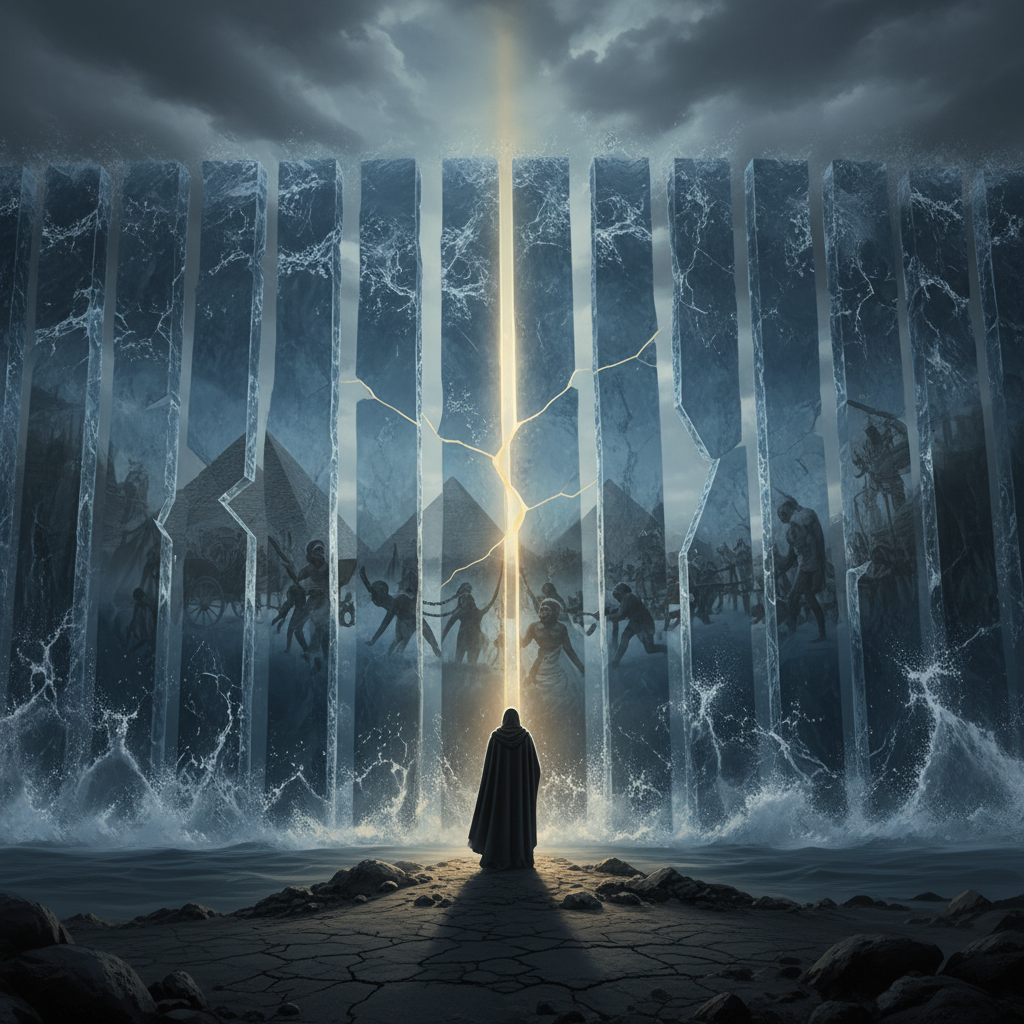
The Midrash Shemot Rabbah (20:11) specifies that the sea did not split into a single block, but into twelve distinct paths, one for each tribe. This image is a fundamental lesson of spiritual psychology : deliverance is not uniform. Every human group, every individual, possesses their own passage toward freedom. The path of change is never identical for everyone ; each must cross their “personal sea” according to their own sensitivity and history.
Transparency and Collective Support
The Midrash adds a fascinating dimension : the walls of water were like glass, transparent. The tribes could see one another during the crossing.
- Mutual encouragement : By seeing others moving forward, the people discovered they were not alone in their transformation.
- Inner clarity : This transparency symbolizes regained lucidity. By emerging from confusion and fear, man finally begins to see reality as it is, without the filters of his traumas.
The First Step : The Act of Nahshon
In rabbinic tradition, the sea did not open by magic at Moses’ passage, but only after Nahshon ben Amminadab took the first step, the water reaching his nostrils. The message is clear : spiritual transformation begins with an act of trust that exceeds rational calculation. The miracle does not precede the action, it responds to it. It is at that instant that the fluid water becomes a solid wall : what was chaotic in your life suddenly becomes a stable structure.
4. Intention : The Secret of the “Pepper” and Free Will
The miracle of the sea also poses a major ethical question : if Israel’s slavery was predicted in the Torah, why is Pharaoh punished ?
The Midrash and Hasidic thought provide a subtle answer here regarding free will and intention.
The trial may be inscribed in the divine plan. But the way an individual participates in it remains their choice.
Pharaoh was not just the instrument of a historical destiny. He aggravated the suffering with voluntary cruelty. The Sages say that he “added pepper”.
The lesson is universal. In our lives, certain situations do not depend on us. But the way we experience them : with kindness or hardness, with faith or cynicism, defines our true moral stature.
Free will resides in the intention that drives the action.
5. Crossing with one’s imperfections
The Mechilta reports a magnificent detail : even after the sea had split, the ground was not perfectly smooth.
In places, mud remained, sometimes even shells.
This mud is us.
It is our wounds, our hesitations, our imperfections.
The Midrash does not present an ideal crossing. It shows a people moving forward despite their fragilities.
God does not ask for perfection before departure.
He simply asks to walk.
Even if the path is still slippery.
Even if we still carry the traces of the inner Egypt.
Conclusion : Splitting one’s own sea
The crossing of the sea marks a decisive moment in Israel’s consciousness.
Before the sea, the people cry out in fear.
After the sea, they sing the Shirat Hayam, the song of the sea.
This transition from fear to song summarizes the entire spiritual psychology of the Midrash : transformation consists not only in escaping danger, but in changing the way one perceives reality.
The sea then becomes a universal metaphor.
Every human being finds themselves one day facing a barrier that seems impassable. But it is often precisely in that place that the passage toward a broader consciousness begins.
Do not be afraid of the dead end.
For behind every closed sea perhaps already hides the path that the Creator is waiting for you to discover.
Source : Midrash Shemot Rabbah 20:11
« And the waters were a wall for them on their right and on their left. » (Exodus 14,22)
Rabbi Yochanan said : the waters were not simply standing like an ordinary wall, but like transparent walls, similar to glass. The tribes of Israel could thus see one another through the waters.
Rabbi Yehuda said : the sea did not open into a single path, but into twelve paths, one for each tribe. Each of the tribes passed through its own passage.
And when the tribes passed, they said to one another : « I am walking on the sea, and you too are walking on the sea ! » Then they rejoiced together and praised the Holy One, blessed be He.
Rabbi Levi said : the waters were solidified like stones, as it is said :
« The floods congealed in the heart of the sea. » (Exodus 15,8)
Thus the Holy One, blessed be He, performed for Israel a miracle within a miracle : the sea split, the waters stood like walls, and Israel passed through the middle of the sea on dry land.
Deepen your study of the Midrash
The richness of the Jewish tradition lies in its millennial texts. To further explore the secrets of the giving of the Torah and the fascinating narratives of our Sages, I invite you to discover my works.
- Exclusive translations : Find the Midrash Shemot Rabbah, faithfully translated into French and English.
- A bridge between cultures : Commentaries accessible to Jewish, Christian, Muslim and secular audiences.
👉 Browse the Midrashim.com shop and order my books