
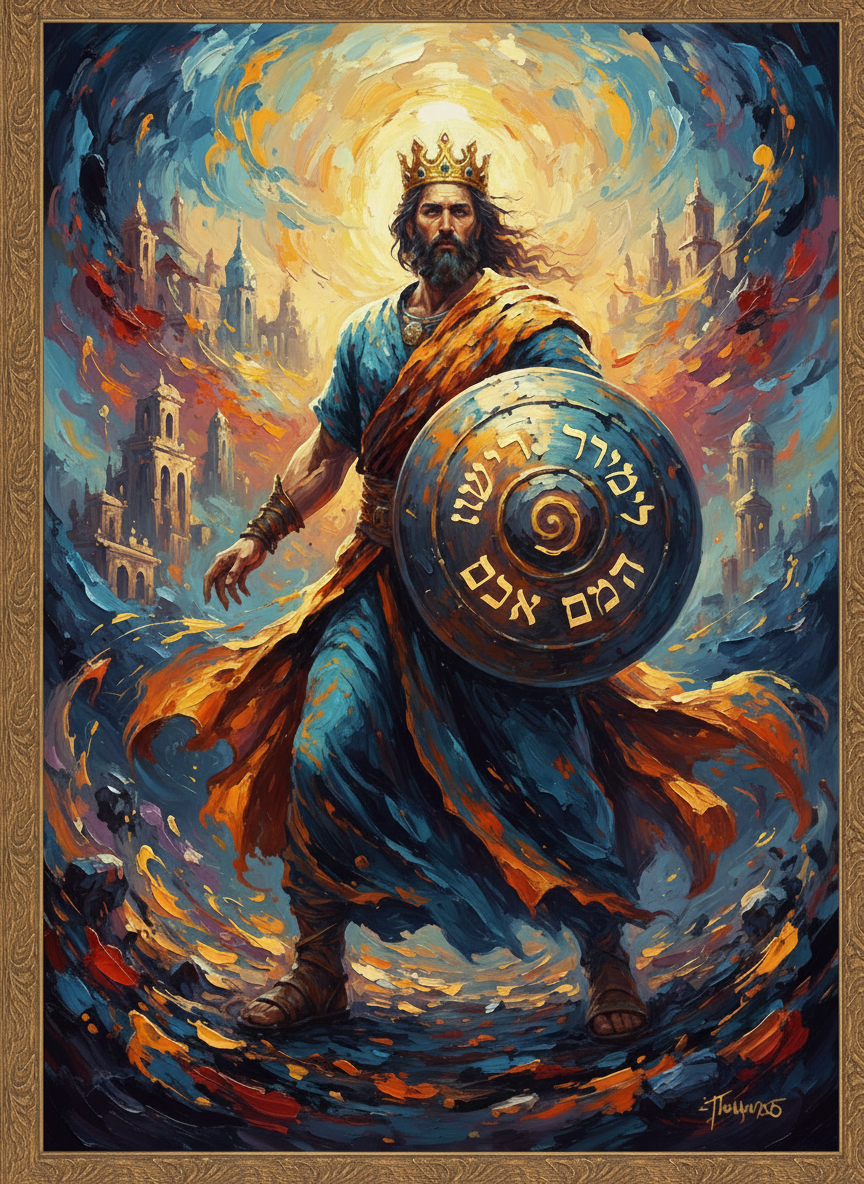
Moral Leadership and Biblical Royalty
Midrashic References
מות רבה ב׳:ב׳ – הקב”ה אינו נותן גדולה לאדם עד שבודקו בדבר קטן. בדק לדוד בצאן… אמר הקב”ה: נמצאת נאמן בצאן, בא ורעה צאני
(Midrash Shemot Rabba 2:2) : The Holy One, blessed be He, does not grant greatness to a man until He has tested him in small things. He tested David with the small livestock… God said: ‘You have been found faithful with the sheep, come and shepherd My flock’.
בראשית רבה צ”ט:ח’ – יהודה, אתה יודוך אחיך… על שהודית במעשה תמר
(Midrash Bereshit Rabba 99:8) : ‘Judah, your brothers shall praise you…’ because you acknowledged the truth in the matter of Tamar, your brothers will crown you king.
There exists in human history an enigma that defies all logic.
A lineage born more than four thousand years ago, fragile, without a stable territory, without a permanent army, without lasting political power… and yet still present.
Tradition affirms that this continuity is not a coincidence. It rests on a founding promise:
the royalty originating from the lineage of Judah will never be extinguished.
This is not a simple poetic metaphor.
It is a spiritual law deeply inscribed in human history.
A Promise Stronger than History
In the biblical texts, when the patriarch Jacob addresses his children before passing away, he does not pass on a material inheritance. He reveals a true structure of the world. At this moment in the history recounted in (Genesis 49), the nascent family is but a small group lost in the midst of Egypt. Absolutely nothing suggests its survival.
And yet, the prophecy affirms that from Judah shall emerge an eternal royalty.
Centuries pass: exiles, persecutions, destructions, gigantic empires that rise and collapse.
Everything eventually disappears… except for this specific lineage.
Even when all seems definitively lost — as during the royal upheavals described in the (Book of Kings) or during the Babylonian exile — a remnant invariably survives. A child. A spark. An unfailing continuity.
This majestic phenomenon surpasses any purely sociological explanation. It touches upon a much deeper law: when the human being aligns with the moral order willed by the Creator, something durable and immutable is established in the world.
Why Judah?
The question arises acutely and proves to be essential.
His brother Joseph was unquestionably more brilliant.
More strategic.
More visionary.
And yet, the mantle of royalty is not transmitted through him.
For what fundamental reason?
Because biblical royalty is not founded on intellectual genius, nor on performance, nor on the brilliance of visible success. It rests on a singularly more discreet quality: moral faithfulness.
Unlike other historical figures, Judah never seeks to redefine good according to his own personal logic.
He does not try to bypass the universal law when it inconveniences him.
He courageously accepts responsibility, even at moments when it costs him immensely.
He may happen to fall; just as King David will later fall in (2 Samuel 12) but when he is intimately confronted with the truth, he does not defend himself with pride. He acknowledges his wrongs. He stands tall with dignity.
It is precisely this exceptional capacity that founds the entire moral legitimacy of true leadership.
A Universal Law Before Being Jewish
This sovereign principle does not exclusively concern the history of Israel.
It directly touches the very foundation of all humanity.
Since the story of Noah in (Genesis 9), humanity rests on a few simple spiritual and ethical foundations:
recognizing that there is a moral authority above man,
preserving life, justice, and dignity,
refusing wanton violence, theft, and moral corruption,
building a society founded on responsibility and universal justice.
These great principles do not, in reality, require scholarly erudition or complex mysticism.
They require, above all, faithfulness.
And it is precisely at this deep level that everything is at stake for societies.
The Danger of Intelligence Without Submission
Intelligence is undeniably a blessing.
Sensitivity is a magnificent wealth.
But when they become totally autonomous, detached from a superior moral framework, they inevitably end up turning destructively against man.
This is what human history implacably demonstrates:
great civilizations never collapse simply due to a lack of technological or academic knowledge,
they fall heavily when they refuse to recognize any limits.
The figure of Judah, meanwhile, embodies an entirely different dimension:
that precious capacity to say yes to what is objectively right, even when that decision flatters neither the ego nor the intellect.
True Royalty: To Serve, Not to Dominate
In biblical thought, the exercise of royalty is never conceived as personal or absolute power.
It is a heavy responsibility in the service of a much larger cosmic and moral order.
This is the reason why the monarchs descended from the lineage of Judah do not reign by simple brute force, but by infinite faithfulness to a divine Law that surpasses and frames them.
Even when they happen to fall, they do not arrogantly redefine the boundaries of good and evil for their personal convenience.
They return from their errors. They take responsibility for their acts. They repair the damage caused.
It is exactly this posture of humility that traverses and defies the centuries of human history.
A Lesson for Our Time
Our contemporary world excessively overvalues intellectual understanding, raw emotion, and personal opinion.
In this vision, everything must be explained, deeply felt, and internally validated by the individual.
But biblical wisdom makes it its duty to remind us of a completely different reality:
the perennial stability of our world does not rest on the ephemeral feelings of man,
but uniquely on the moral principles to which he decides to remain faithful.
One may perfectly well not understand everything about events.
One may go through periods of doubt.
But one has the duty to remain morally upright.
It is this, and this alone, that allows a true civilization to remain standing in the face of adversity.
A Faithfulness That Transcends Peoples
King David‘s royalty is not merely an epic confined to Jewish history.
It masterfully embodies a universal truth:
👉 A society holds fast only as long as it rigorously respects a moral framework greater than itself.
👉 A humanity survives durably as long as it has the lucidity to recognize that it is not the ultimate and arbitrary source of good and evil.
When this indispensable humility before the divine disappears, the entire social and spiritual edifice becomes dangerously fragile.
In Conclusion
The nobility and royalty of the lineage of Judah are not deemed eternal because they possess an invincible strength.
They are eternal because they reveal themselves to be unfailingly faithful.
Faithful to a superior transcendent Law.
Faithful to a demand and a moral responsibility.
Faithful to the noble idea that man is not the absolute center of the universe, but its humble and worthy guardian as prescribed since (Genesis 2:15).
And as long as men and women of all nations freely choose to embrace this silent and authentic faithfulness
the world will inevitably continue to stand.
Deepen your study of the Midrash
The Exodus from Egypt still hides many secrets. To explore full commentaries on the plagues and the psychology of the Patriarchs through original texts, I invite you to discover my work.
- Exclusive translations: Find the Midrash Shemot Rabba and many other classic texts, faithfully translated into French and English.
- A bridge between cultures: Commentaries accessible to Jewish audiences, Christians, Muslims, and secular readers.
👉 Browse the Midrashim.com store and order my books