
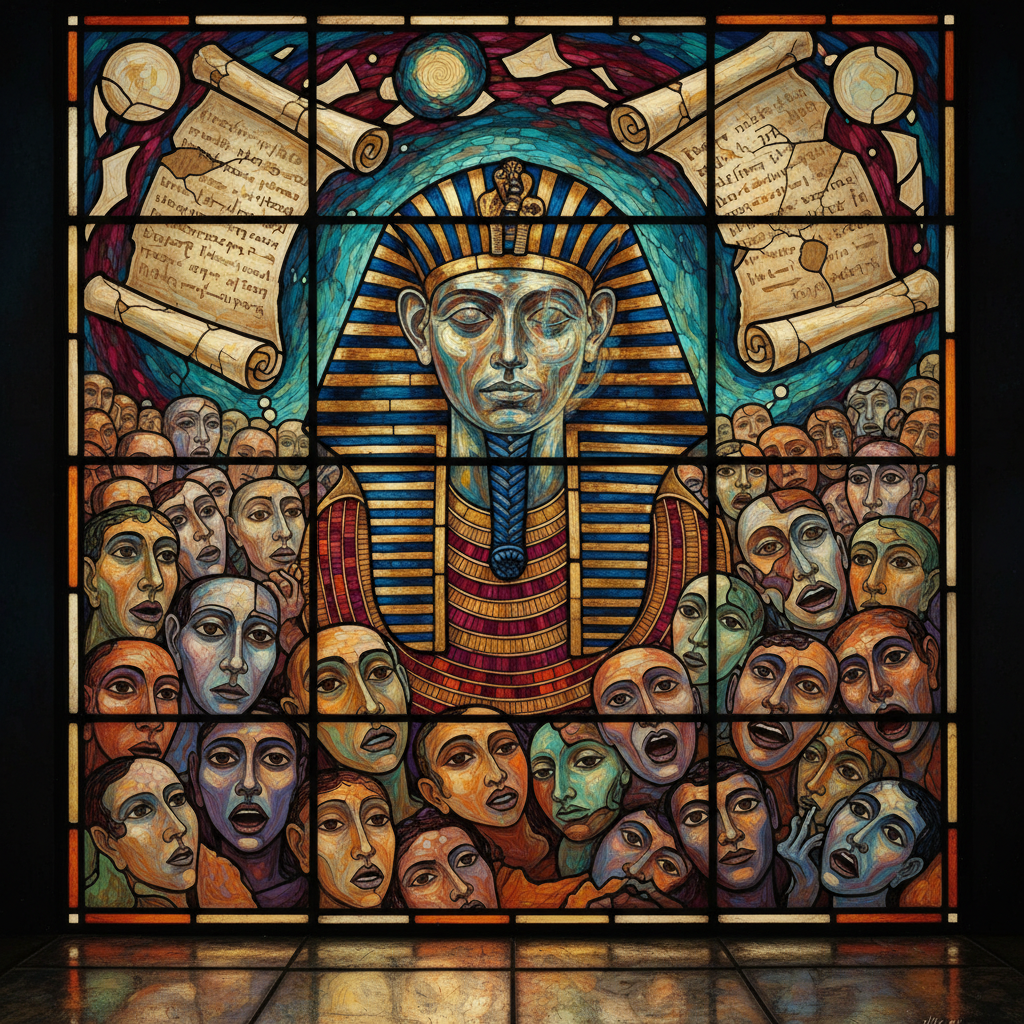
Analysis of the Midrash: Memory, Power, and Identity
A Political and Secular Reading of Oppression in Egypt
Introduction
The text of the Midrash Exodus Rabbah (Chapter 1-7) offers a complex exegesis of the verse from Exodus (1:8): “A new king arose over Egypt, who did not know Joseph.” This passage, a central pivot of the biblical narrative marking the transition from hospitality to slavery, is dissected by the Sages through a series of philological and narrative debates.
The Midrash does not merely fill in the gaps of the sacred text; it offers a sharp reflection on the nature of power and the psychology of nations. The text is structured around three major axes: the nature of political change, the dynamics of populism, and the dialectic of assimilation. In this analysis, we will adopt a double perspective: that of contemporary political science and that of a universal secular philosophy.
The Rewriting of History and Political Amnesia
The first controversy reported by the Midrash opposes Rav and Samuel on a fundamental question: does tyranny arise from a change in man or a change in structure?
- One argues that there was actually a new king (based on the word “new”).
- The other asserts that it was his decrees that were renewed, arguing that it is not written “he died and another reigned”.
This second option suggests an institutionalist reading of power: the individual matters little, it is the policy that mutates. The most striking element is the interpretation of the phrase “who did not know Joseph”. The Midrash specifies: “He acted as if he did not know Joseph at all”.
We are here faced with the Orwellian concept of the rewriting of history. Joseph, the economic savior, becomes a historical “non-being”. For a regime to designate a scapegoat, it must first erase the moral debt toward that group. The “new king” is a metaphor for political opportunism that chooses to forget yesterday’s alliances to consolidate today’s power.
The Constrained Dictator: Populism and Political Survival
The Midrash then deconstructs the myth of the omnipotent despot by recounting that the Egyptians said to Pharaoh: “Come, let us attack this nation”. Pharaoh first refuses out of realism: “Until now, we live off what belongs to them… Without Joseph, we would not be alive”.
It is here that the text becomes a lesson in political science: because he refuses to listen to the crowd, they deposed him from his throne for three months. Pharaoh only regains his throne by capitulating: “Whatever you want, I am with you”.
For a modern audience, this narrative shows that xenophobia can rise from the bottom to the top. Pharaoh appears as a pragmatic leader overwhelmed by a populist wave. To keep his title, he must renounce his moral sovereignty. The Midrash teaches us that hatred of the other is a social cement so powerful that a leader, even an absolute one, cannot oppose it without risking his own fall.
The Paradox of Assimilation: A Sociological Analysis
Finally, the Midrash introduces a sociological dimension by linking oppression to the behavior of the Hebrews. Relying on the prophet Hosea (“They have betrayed the Lord… now a month shall devour their portions”), the Sages explain that upon the death of Joseph, the Hebrews broke the covenant of circumcision, saying: “Let us be like the Egyptians”.
From a secular point of view, this passage describes the tragic mechanism of failed assimilation. The Hebrews attempt to erase their difference to blend into the mass, hoping thus to guarantee their safety. Yet, the text notes that it is precisely then that “the Holy One, blessed be He, changed the love that the Egyptians bore them into hatred”.
Political analysis reveals a cruel irony: far from appeasing hostility, the erasing of distinctive signs seems to exacerbate the hatred of the majority. Renouncing oneself can be perceived by the other as an intrusion or a concealment, generating increased mistrust. By seeking to disappear as a distinct group, they facilitated their transformation into objects of enslavement. The safety of a minority would therefore not lie in mimicry, but in the dignified assumption of its identity.
Conclusion
Through the analysis of this Midrash, stripped of its purely religious shell, an eternal reflection on the dynamics of power emerges. The text warns us that tyranny is rarely the work of a single man, but the result of a convergence between elite opportunism and popular pressure.
Sources:
Midrash Exodus Rabbah Chapter 1:7
“A new king arose”: when the Egyptians saw this, they renewed the decrees against them. Rav and Samuel diverge: one says that it was actually a new king, the other says that it was his decrees that were renewed. The argument of the one who says “a new king” is based on the word “new”; the argument of the one who says it was his decrees is that it is not written “he died and another reigned”.
“Who did not know Joseph”: according to the one who says it was a new king, this is easily explained; according to the one who says he renewed his decrees, how does he interpret this? He acted as if he did not know Joseph at all.
The Sages say: Why is he called a “new king” when it was Pharaoh himself? It is because the Egyptians said to Pharaoh: “Come, let us attack this nation.” He replied to them: “You are fools! Until now, we live off what belongs to them (thanks to Joseph), how could we attack them? Without Joseph, we would not be alive.” Since he would not listen to them, they deposed him from his throne for three months, until he said to them: “Whatever you want, I am with you.” Then they restored him. That is why it is written: “A new king arose”.
The Sages open this verse with the one from Hosea (5, 7): “They have betrayed the Lord, for they have begotten foreign children; now a month (Hodesh) shall devour their portions.” This teaches you that at the death of Joseph, they broke the covenant of circumcision, saying: “Let us be like the Egyptians.” From here you learn that Moses circumcised them upon their departure from Egypt. And because they acted thus, the Holy One, blessed be He, changed the love that the Egyptians bore them into hatred, as it is said (Psalms 105, 25): “He changed their heart to hate His people”.
“A new king”: who arose and renewed his decrees against them. “Who did not know Joseph”: Is it possible that he did not know Joseph? Rabbi Abin said: It is like someone who stoned the king’s friend. The king said: “Behead him, for tomorrow he will do the same to me.” That is why Scripture writes about him: today he “did not know Joseph”, tomorrow he will say: “I do not know the Lord” (Exodus 5, 2).
“He said to his people”: he was the first to advise (evil), therefore he was the first struck. He advised first: “He said to his people”, and he was struck first: “[The frogs shall come up] on you, on your people and on all your servants” (Exodus 7, 29).