
Back Cover
The Midrash Rabbah is one of the pillars of classical Jewish thought.
Through Shemot Rabbah, the Sages reread the story of the Exodus not as a simple historical chronicle, but as a profound reflection on servitude, power, and human responsibility.
Why is Moses chosen?
What really triggers the deliverance of Israel?
What is the place of man in the face of institutionalized injustice?
This book offers a fluent and accessible French translation of Shemot Rabbah, accompanied, for each unit of text, by a clear summary and a reading key intended for the contemporary reader. The goal is not erudition for its own sake, but the understanding of the ethical and spiritual message carried by the Sages.
Far from a commentary reserved for specialists, Shemot Rabbah appears here as a text of striking relevance today. It questions the nature of power, the temptation of indifference, and the moral conditions without which no liberation is possible.
Intended for both Jewish and non-Jewish readers wishing to understand rabbinic biblical thought, this work aims to be a bridge between the ancient text and the fundamental questions of the modern world.
“Midrashim” Collection www.midrashim.com
MIDRASH EXODUS RABBAH – PARASHA SHEMOT
Chapter 1
1. The Vital Role of Discipline
The text opens by connecting the listing of Jacob’s sons to the proverb regarding the rod and discipline. It argues that withholding discipline leads to ruin and hatred, citing the failures of Abraham with Ishmael, Isaac with Esau, and David with his sons Absalom and Adonijah. Conversely, it praises the discipline applied to Isaac and Jacob, which led to their righteousness. This concept is extended to God’s relationship with Israel, asserting that God chastises Israel specifically because He loves them, granting them the Torah, the Land, and the World to Come through suffering.
“And these are the names of the sons of Israel who came to Egypt with Jacob; each man and his household came” (Exodus 1:1). This relates to the verse: “He who spares his rod hates his son, but he who loves him disciplines him early” (Proverbs 13:24).
Ordinarily, in the ways of the world, if a man is told by his friend, “So-and-so struck your son,” he would pursue that person to the point of risking his life. What then does “He who spares his rod hates his son” come to teach us? To teach you that anyone who withholds discipline from his son will eventually see him fall into evil ways and will come to hate him.
Thus we find with Ishmael, for whom his father Abraham felt great affection. Because he did not rebuke him, Ishmael fell into evil ways; Abraham eventually hated him and sent him away from his house empty-handed. What did Ishmael do? When he was fifteen years old, he began bringing idols from the marketplace, playing with them and worshipping them, just as he had seen others do. Immediately: “Sarah saw the son of Hagar the Egyptian, whom she had borne to Abraham, mocking (metzahek)” (Genesis 21:9). Now, “mocking” refers to nothing other than idolatry, as it is said: “And they rose up to play (letzahek)” (Exodus 32:6—regarding the Golden Calf). Immediately: “She said to Abraham: Cast out this bondwoman and her son… lest my son learn his ways.” Immediately: “And the matter was very grievous in Abraham’s sight… because he had gone into evil ways.” God said to Abraham: “Let it not be grievous in your sight…”; from here you learn that Abraham was secondary to Sarah in prophecy.
Immediately: “And Abraham rose up early in the morning, and took bread and a skin of water…”, to teach you that he now hated Ishmael because he had turned to evil, and he sent him and his mother Hagar away empty-handed, driving him from his house for that reason. For would it enter your mind that Abraham, of whom it is written: “Abram was very rich in cattle, in silver, and in gold,” would send away his wife and son without clothing or sustenance? Rather, it is to teach you that once he turned to evil ways, Abraham no longer cared for him. What was his end? After being driven out, he sat at the crossroads and became a highwayman who robbed people, as it is said: “And he shall be a wild ass of a man” (Genesis 16:12).
Similarly, “Isaac loved Esau“ (Genesis 25:28). Therefore, Esau fell into evil ways because his father did not rebuke him. As we have learned, Esau the wicked committed five transgressions on that day: he violated a betrothed maiden, committed murder, denied the resurrection of the dead, denied the Fundamental Principle (God), and despised the birthright. Furthermore, he craved his father’s death and sought to kill his brother, as it is said: “Let the days of mourning for my father be at hand…”. He caused Jacob to flee from his parents, and he himself went to Ishmael to learn evil ways from him and to add to his wives, as it is said: “And Esau went unto Ishmael.”
Likewise with David, who did not chastise his son Absalom nor rebuke him; he fell into evil ways and sought to kill his father, lay with his concubines, and caused him to flee barefoot and weeping. Because of him, many thousands and tens of thousands fell from Israel, and he caused David many endless hardships, as it is written: “A Psalm of David, when he fled from Absalom his son.” And what is written afterward? “O Lord, how many are my adversaries!” For evil ways within a man’s own household are harder to bear than anything.
…from the war of Gog and Magog. For regarding the war of Gog and Magog it is written: “Why do the nations rage?” (Psalms 2:1), and further it is written: “O Lord, how many are my foes” (Psalms 3:2). Similarly, David acted with Adonijah by not rebuking him with discipline or chastising him; therefore, he turned to evil ways (lit. “went out to an evil culture”), as it is written: “His father had never saddened him in all his days” (I Kings 1:6), and it is written: “And he was born after Absalom” (I Kings 1:6). But was not Absalom the son of Maacah and Adonijah the son of Haggith? What then is the meaning of “he was born after Absalom”? Rather, because he turned to evil ways and his father did not discipline him and it is written of Adonijah that his father never saddened him he too turned to evil ways [like Absalom]; therefore, it is written: “he was born after Absalom.”
“And he who loves him seeks him with discipline” (Proverbs 13:24): This refers to the Holy One, Blessed be He, who, because He loved Israel as it is written: “I have loved you, says the Lord” (Malachi 1:2) multiplies their suffering. You find that the Holy One, Blessed be He, gave three good gifts to Israel, and He gave none of them except through suffering: the Torah, the Land of Israel, and the life of the World to Come. The Torah, as it is written: “Happy is the man whom You discipline, O Lord, and whom You teach from Your Torah” (Psalms 94:12). The Land of Israel, as it is written: “And you shall know in your heart [that as a man disciplines his son, so the Lord your God disciplines you]” (Deuteronomy 8:5), and what is written after it? “For the Lord your God is bringing you into a good land” (Deuteronomy 8:7). The World to Come, as it is written: “For the commandment is a lamp and the Torah is light… [and the reproofs of discipline are the way of life]” (Proverbs 6:23).
Whoever disciplines his son causes the son to increase his love for his father and to honor him, as it is said: “Discipline your son, and he will give you rest” (Proverbs 29:17), and it says: “Discipline your son while there is hope” (Proverbs 19:18). This increases love for him, as it is said: “And he who loves him seeks him with discipline”; because he seeks him with discipline, therefore he loves him. You find that Abraham disciplined his son Isaac and taught him Torah and guided him in his ways, as it is written of Abraham: “Because Abraham obeyed My voice” (Genesis 26:5). And it is written: “These are the generations of Isaac, son of Abraham” (Genesis 25:19), to teach you that he was like his father in every way: in beauty, wisdom, wealth, and good deeds. Know that he was thirty-seven years old when his father bound him on the altar; and although it is written: “Abraham was old, advanced in years” (Genesis 24:1), he bound him and tied him like a lamb, and Isaac did not refuse. Therefore: “Abraham gave all that he had to Isaac” (Genesis 25:5); this is the meaning of: “and he who loves him seeks him with discipline.”
Similarly, Isaac sought discipline for Jacob, for Isaac taught him Torah and disciplined him in his house of study, as it is said: “Jacob was a plain man [dwelling in tents]” (Genesis 25:27), and he learned what his father taught him. Afterward, he departed from his father and hid in the House of Eber to study Torah. Therefore, he merited blessing and inherited the land, as it is said: “And Jacob dwelt in the land of his father’s sojournings, in the land of Canaan” (Genesis 37:1). And Jacob our father also disciplined his sons and rebuked them and taught them his ways, so that there was no dross in them. Thus it is written: “And these are the names of the sons of Israel who come to Egypt”; Scripture equates them all to Jacob, for they were all righteous as he was. This is: “and he who loves him seeks him with discipline.”
Another explanation: “And these are the names.” Rabbi Abbahu said: Wherever it says “These” (Eleh), it disqualifies that which came before; but “And these” (Ve-eleh) adds praise to the former. “These are the generations of the heaven and the earth” (Genesis 2:4) disqualified the Tohu and Bohu. “And these are the names” adds praise to the seventy souls mentioned above, for they were all righteous. “And these are the names of the children of Israel who come to Egypt with Jacob… every man and his household came.” Israel is weighed as equal to the host of heaven. Here it says “names,” and regarding the stars it says “names,” as it is said: “He counts the number of the stars; He calls them all by names” (Psalms 147:4). So too, when Israel went down to Egypt, the Holy One, Blessed be He, counted their number, and because they are compared to stars, He called them all by names. This is what is written: “And these are the names of the children of Israel…”
“Who come (Haba’im) to Egypt”: Does it mean they are coming today? Had they not already been in Egypt for many days? Rather, as long as Joseph was alive, they did not feel the burden of the Egyptians; when Joseph died, they placed the burden upon them. Therefore, it is written “who come,” as if they entered Egypt on that very day. “With Jacob”: all these were through the power of Jacob, who gathered commandments and good deeds, and merited to establish twelve tribes. “Every man and his household came.”
2. Prophetic Symbolism of the Tribes’ Names
The commentary analyzes the specific names of the tribes, interpreting them not just as identifiers but as prophetic allusions to Israel’s future redemption and relationship with God (e.g., Reuben seeing affliction, Simeon hearing prayers). It also addresses the non-chronological listing of the tribes, explaining that this creates equality between the sons of the wives and the handmaids, positioning them all as the structural “ceiling of the world.”
“And these are the names of the children of Israel”: they are mentioned here for the sake of the redemption of Israel.
REUBEN: as it is said: “I have surely seen (Raoh raïti) the affliction of My people” (Exodus 3:7).
SIMEON: on account of: “And God heard (Vayichma) their groaning” (Exodus 2:24).
LEVI: because the Holy One, Blessed be He, joined Himself (Nit-haber) to their trouble: “from the midst of the bush” (Exodus 3:2), to fulfill what is said: “I will be with him in trouble” (Psalms 91:15).
JUDAH: because they gave thanks (Hodou) to the Holy One, Blessed be He.
ISSACHAR: because the Holy One, Blessed be He, gave them the reward (Sekhar) for their servitude: the spoil of Egypt and the spoil of the sea, to fulfill what is said: “and afterward they shall come out with great substance” (Genesis 15:14).
ZEBULUN: because the Holy One, Blessed be He, caused His Presence (Shekhinah) to dwell in their midst, as it is said: “And let them make Me a sanctuary, that I may dwell among them” (Exodus 25:8); and “Zebulun“ refers to the Temple, as it is said: “I have surely built a house of habitation (Zebul) for You” (I Kings 8:13).
BENJAMIN: on account of: “Your right hand (Yeminekha), O Lord, is glorious in power” (Exodus 15:6). DAN: on account of: “And also that nation whom they shall serve will I judge (Dan anokhi)” (Genesis 15:14).
NAPHTALI: on account of the Torah and commandments which the Holy One, Blessed be He, gave them, of which it is written: “Sweeter also than honey and the honeycomb (Nofet tzufim)” (Psalms 19:11).
GAD: on account of the manna that the Holy One, Blessed be He, fed them, which was “like coriander seed (Gad)” (Exodus 16:31).
ASHER: because all who heard of their redemption and greatness praised them (Me-achrin), as it is written: “And all nations shall call you happy (Ichrou), for you shall be a delightsome land” (Malachi 3:12).
JOSEPH: because the Holy One, Blessed be He, will in the future again (Yosif) redeem Israel from the wicked kingdom just as He redeemed them from Egypt, as it is written: “And it shall come to pass in that day, that the Lord will set His hand again (Yosif) the second time…” (Isaiah 11:11).
This is what Rabbi Joshua of Sikhnin said in the name of Rabbi Levi: Why are the names of the tribes not listed in the same order in every place? Rather, sometimes this one precedes that one, and sometimes that one precedes this one. This is so that people should not say that the sons of the mistresses (Leah and Rachel) come first and the sons of the handmaids (Bilhah and Zilpah) come last; to teach you that these were not greater than those. Another explanation: Why did He put these before those? Because they are the “ceiling of the world.” One who fixes a ceiling properly places the thickness of one beam next to the head of another that is not equal, therefore He alternates their order. And from where do we know they are the ceiling of the world? As the prophet Isaiah says: “Listen to me, O Jacob, and Israel, my called one” (Isaiah 48:12).
“And all the souls that came out of the loins of Jacob… with Joseph who was in Egypt, were seventy.” Another explanation: “And Joseph was in Egypt” — although Joseph attained kingship, he did not become haughty toward his brothers or his father’s house. Just as he was small in his own eyes at the beginning when he was a slave in Egypt, so he remained small in his own eyes after he became king.
3. The Death of Joseph and Miraculous Growth
Following the death of Joseph—who remained humble despite his power—and his entire generation, the text describes the supernatural fertility of the Israelites. The women gave birth to multiple children at once (counts ranging from six to twelve), causing the population to “swarm” and fill the land, which triggered Egyptian anxiety.
“And Joseph died, and all his brothers, and all that generation.” This teaches you that as long as one of those who went down to Egypt remained alive, the Egyptians did not enslave Israel. “And the children of Israel were fruitful and swarmed” — although Joseph and his brothers died, their God did not die; rather, “the children of Israel were fruitful and swarmed.” Another explanation: Each woman gave birth to six at one birth, as it is said: “And the children of Israel were fruitful (1), and swarmed (2), and multiplied (3), and became mighty (4), in very (5) much (6).” Some say twelve, as it is written: fruitful (2), swarmed (2), multiplied (2), became mighty (2), in very much (2), and the land was filled with them (2) — making twelve. “And they became mighty”: some say six at one birth. And do not be surprised, for the scorpion, which is among the swarming things, gives birth to seventy. Rabbi Nathan says: “And the land was filled with them” like thickets of reeds.
4. The New King’s Counsel and Betrayal
A “new” king arises (interpreted as either a literal new ruler or one with renewed, harsher decrees) who chooses to ignore Joseph’s past contributions. Fearing Israel’s numbers, he consults with Balaam, Job, and Jethro. They plot to subjugate the Israelites, specifically choosing water as the means of destruction to avoid the divine retribution associated with the sword, though this plan ultimately leads to their own drowning.
“Now there arose a new king”: when the Egyptians saw this, they renewed decrees against them; this is what is written: “And there arose a new king.” Rav and Shmuel disagree: one says it was literally a new king, and the other says his decrees were renewed, meaning he innovated decrees and punishments against them. The reason for the one who says “literally a new king“ is because it is written “new.” The reason for the one who says “he renewed his decrees“ is because it is not written “he died and another reigned.” “Who knew not Joseph”: according to the one who says it was a new king, it is understandable; according to the one who says he renewed his decrees, how does he interpret this? It means he acted as though he did not know Joseph at all.
The Rabbis say: Why is he called a “new king” if he was Pharaoh himself? Because the Egyptians said to Pharaoh: “Come, let us plot against this nation.” He said to them: “You are fools! Until now we have been eating from what is theirs (due to Joseph), so how can we plot against them? Were it not for Joseph, we would not be alive.” When he would not listen to them, they removed him from his throne for three months, until he said to them: “Whatever you desire, I am with you,” and they restored him. Therefore, it is written: “And there arose a new king.”
The Rabbis opened the discussion of this verse with the passage (Hosea 5:7): “They have betrayed the Lord, for they have begotten foreign children; now a month (Hodesh) shall devour them along with their portions.” This teaches you that when Joseph died, they abolished the covenant of circumcision, saying: “Let us be like the Egyptians.” From here you learn that Moses circumcised them upon their departure from Egypt. And because they did this, the Holy One, blessed be He, turned the love the Egyptians had for them into hatred, as it is said (Psalms 105:25): “He turned their heart to hate His people, to plot against His servants,” to fulfill what is said: “Now a month shall devour them.” “A new king”: who arose and renewed his decrees against them. “Who knew not Joseph”: Could it be that he did not know Joseph? Rabbi Abin said: It is like a parable of one who stoned the king’s friend. The king said: “Behead him, for tomorrow he will do the same to me.” Therefore the Scripture wrote of him: today he “did not know Joseph,” and tomorrow he is destined to say: “I do not know the Lord” (Exodus 5:2).
5. The Nature of the Egyptian Oppression
The oppression is described as calculated and psychological. Pharaoh himself participated in labor to force the Israelites’ compliance through shame. The servitude included impossible tasks, such as switching gender roles in labor, and forcing them to build on unstable ground. However, despite these efforts to diminish them, God ensured that the more they were afflicted, the more they multiplied.
“And he said to his people”: he was the first to give counsel, therefore he was the first to be smitten. He was the first to counsel, as it is written: “And he said to his people,” and he was smitten first, as it is written (Exodus 7:29): “And upon you, and upon your people, and upon all your servants [shall the frogs come up].” “Come, let us deal wisely with him (lo)”: it does not say “with them” but “with him.” Rabbi Hama son of Rabbi Hanina said: He said, “Come and let us deal wisely with their God. If we judge them by the sword, it is already written: ‘For by His sword the Lord will judge all flesh’ (]Isaiah 66:16) Let us judge them only with water, for so the Holy One, blessed be He, swore that He would not bring a flood upon the world, as it is said (]Isaiah 54:9).: ‘As I have sworn that the waters of Noah should no more go over the earth.'” But they did not know that He would not bring a flood upon the entire world, but upon one nation He would; and upon them He would not bring it, but they would come and fall into it, as it is said: “They shall be poured out by the sword; they shall be a portion for foxes” (Psalms 63:11). “For in the thing wherein they dealt proudly (zadu)…” (Exodus 18:11): in the pot they cooked, they themselves were cooked. Rabbi Hiyya said in the name of Rabbi Simon: Three were in that counsel: Balaam, Job, and Jethro. Balaam who advised was killed. Job who was silent was judged with suffering. Jethro who fled—his descendants merited to sit in the Chamber of Hewn Stone (the Sanhedrin).
“And get him up out of the land”: it does not say “and we shall go up” but “and he shall go up.” Rabbi Abba bar Kahana said: It is like a man who curses himself but hangs his curse on others. Another explanation: “And get him up out of the land”—whenever Israel is at the lowest descent, they rise. David said: “For our soul is bowed down to the dust; our belly cleaves to the earth” (Psalms 44:26). At that moment: “Arise for our help, and redeem us for Your mercy’s sake” (44:27).
“And they set over him”: it does not say “over them” but “over him.” The School of Rabbi Eleazar son of Rabbi Simeon taught: this teaches that they brought a brick-mold and hung it around Pharaoh’s neck. If any Israelite said to them, “I am delicate,” they would say to him: “Are you more delicate than Pharaoh?” “Taskmasters (sarei missim)”: something that imposes (massim) bricks. “To afflict him with their burdens”: to afflict Pharaoh with the burdens of Israel. “And he built store cities (miskenot) for Pharaoh“: Rav and Shmuel disagree. One says they endanger (mesakenot) their owners. The other says they impoverish (memaskenot) their builders, for anyone who engages in building becomes impoverished. The Rabbis say: treasure houses. “Pithom and Raamses”: one says its name was Pithom, and why was it called Raamses? Because one by one they would crumble (mitrosses). The other says Raamses was its name, and why Pithom? Because one by one the mouth of the deep (pi tehom) swallowed them.
“But the more they afflicted him, the more he would multiply and the more he would spread out.” It does not say “they multiplied” but “he will multiply” (future tense): Rabbi Shimon ben Lakish said: The Holy Spirit brought them tidings that thus they would multiply. “And they were grieved (vayakoutzou) because of the children of Israel”: this teaches that Israel were in their eyes like thorns (kotzim). “And the Egyptians made the children of Israel serve with rigor (befarekh)”: Rabbi Eleazar said: “with a soft mouth” (be-fe-rakh) [by persuasion]. Rabbi Shmuel bar Nahman said: with crushing. And they did so to every Israelite: whatever work they did on the first day was set as a decree to do the same amount every single day. “And they embittered their lives…”: at first with mortar and bricks, then with all manner of service in the field, and finally with “all their service.” Rabbi Jonathan said: this teaches that they would exchange the work of men for women and the work of women for men.
Pharaoh issued four decrees against them. At first, he commanded the taskmasters to pressure them so they would complete their quota and not sleep in their homes, thinking to diminish them from procreation. The taskmasters said to them: “If you go to sleep in your houses, by the time we send for you in the morning, the day will have advanced and you will not complete your quota.” So they would sleep on the ground. God said to them: “I said to their father Abraham that I would multiply his children like the stars, and you plot so they will not multiply? Let us see whose word stands, mine or yours!” Immediately: “the more they afflicted him, the more he multiplied.”
6. Righteous Women and the Midwives
The survival and redemption of Israel are attributed to the righteous women who maintained family life and seduced their husbands to ensure procreation despite the slavery. They gave birth miraculously in fields, protected by God. The text also identifies the midwives Shiphrah and Puah as Jochebed and Miriam, praising them for defying Pharaoh, preserving the lives of the infants, and standing up for their people.
Rabbi Akiva expounded: In the merit of the righteous women who were in that generation, Israel was redeemed from Egypt. What did they do? When they went to draw water, the Holy One, blessed be He, prepared small fish in their pitchers. They would draw half water and half fish, and bring them to their husbands and cook for them two pots, one of hot water and one of fish. They would feed them, wash them, anoint them, give them drink, and consort with them between the sheepfolds. In reward for lying between the sheepfolds, Israel merited the spoil of Egypt. And when they became pregnant, they would come to their houses, and when the time of birth arrived, they would go and give birth in the field under the apple tree. The Holy One, blessed be He, would send an angel from the high heavens to clean them and beautify them. And He would provide for them two round stones, one of oil and one of honey. When the Egyptians noticed them and wanted to kill them, a miracle was performed for them and they were swallowed into the ground. The Egyptians would bring oxen and plow over them, but after they left, the children would sprout and come up like the grass of the field. When they grew up, they came in great flocks to their homes. And when the Holy One, blessed be He, revealed Himself at the Sea, they recognized Him first, as it is said: “This is my God, and I will glorify Him” (Exodus 15:2).
When he saw that they were appearing and multiplying, he decreed against the males; as it is written (Exodus 1:15): “And the king of Egypt spoke to the midwives, etc.” Who were these midwives? Rav said: A daughter-in-law and her mother-in-law, Jochebed and Elisheba daughter of Amminadab. Rabbi Samuel bar Nachman said: A woman and her daughter, Jochebed and Miriam. Miriam was only five years old then, for Aaron was three years older than Moses. Our Sages of blessed memory said: She used to go with Jochebed her mother and attend to her needs, and she was diligent, for even while a child is small, he is recognizable. This is what Solomon said (Proverbs 20:11): “Even by his deeds a lad is known, etc.”
“The name of one was Shiphrah“: because she would beautify (meshaperet) the newborn when he emerged covered in blood. “Puah“: because she would sputter (nofaat) wine into the infant after its mother. Another interpretation: “Shiphrah,” because Israel fructified (paru) and multiplied because of her. “Puah,” because she would revive (maphia) the infant when people thought it was dead. Another interpretation: “Shiphrah,” because she improved (shiprah) her deeds before God. Another interpretation: “Puah,” because she appeared (hofiah) for Israel before God. Another interpretation: “Puah,” because she stood up (hofiah panim) against Pharaoh; she stuck up her nose at him and said to him: “Woe to that man when God comes to exact punishment from him!” He was filled with fury against her to kill her. “Shiphrah,” because she would smooth over (meshaperet) her daughter’s words and appease him for her sake. She said to him: “Do you pay attention to her? She is but a child and knows nothing.”
Rabbi Hanina bar Rav Isaac said: “Shiphrah,” because she established Israel for God, for whose sake the heavens were created, as it is written (Job 26:13): “By His breath the heavens are bright (shifrah).” “Puah,” because she stood up against her father, for Amram was the head of the Sanhedrin at that hour. When Pharaoh decreed and said: “Every son that is born…”, Amram said: “Is it for naught that Israel begets children?” Immediately, he sent Jochebed away and separated himself from marital relations, and he divorced his wife when she was three months pregnant. All of Israel stood up and divorced their wives. His daughter said to him: “Your decree is harsher than Pharaoh’s. For Pharaoh decreed only against the males, but you decree against males and females. Pharaoh is wicked and it is doubtful whether his decree will be fulfilled, but you are righteous and your decree will certainly be fulfilled.” He stood up and took back his wife, and all Israel stood up and took back their wives. Thus she is “Puah,” for she stood up against her father.
“And he said: When you birth the Hebrew women…”: Why did he command to kill them through the midwives? So that the Holy One, blessed be He, would not demand an accounting from him, but rather punish the midwives. “And you shall see upon the stools (obnayim)”: the place where the child is turned. Another interpretation: “Abnayim“ (stones): Rabbi Judah bar Simon said that the Holy One, blessed be He, makes a woman’s limbs hard like stones at the time she sits upon the birthstool to give birth, for were it not so, she would die. Rabbi Phinehas the Associate said in the name of Rabbi Jonah, supporting Rabbi Judah bar Simon: “Abnayim“ refers only to an anvil, which is a hard thing, as it is written (Jeremiah 18:3): “I went down to the potter’s house, and behold, he was doing work upon the wheels (obnayim).” Rabbi Hanin said: He gave them a great sign. Just as this potter has a thigh on this side and a thigh on that side and the anvil in the middle, so too a woman has a thigh on this side and a thigh on that side and the child in the middle. And some say: at the time she crouches to give birth, her thighs become cold like stones.
“If it be a son, then you shall kill him”: He said to them: “If it is a male, kill him; and if it is a female, do not kill her—but rather, if she lives, she lives, and if she dies, she dies.” They said to him: “How shall we know if it is a male or a female?” Rabbi Hanina said: He gave them a great sign. If its face is downward, know that it is a male, for he looks at his mother towards the earth from which he was created. And when its face is upward, it is a female, for she looks at her creation, at the rib, as it is said (Genesis 2:21): “And He took one of his ribs.” The Holy One, blessed be He, said: “Wicked one! He who gave this advice is a fool. You should have killed the females! If there are no females, where will the males take wives? One woman cannot take two men, but one man can take ten or a hundred women.” This is as written (Isaiah 19:11): “The princes of Zoan are but fools,” for they gave him this advice.
“But the midwives feared God”: of them it is said (Proverbs 31:30): “A woman who fears the Lord, she shall be praised.” “And they did not as the king of Egypt spoke to them”: it does not say “for them” but “unto them” (aleihen). Rabbi Jose bar Hanina said: this teaches that he demanded to have relations with them, but they did not accept his advances. “But they saved the children alive”: Since they did not do as he spoke to them, do we not know that they kept the children alive? Why did the verse need to say: “And they saved the children alive”? There is praise within praise: not only did they not fulfill his words, but they even added to them by doing favors for them. Some mothers were poor, so the midwives went and collected water and food from the houses of the wealthy and gave to the poor ones, and thus they kept their children alive. This is what is written: “And they saved the children alive.”
Some children were destined to emerge lame, or blind, or with defects; what did the midwives do? They stood in prayer and said before the Holy One, blessed be He: “Lord of the Universe, let the child emerge in peace, so that Israel will not find reason to speak against us, saying ‘Behold they emerged with defects because they sought to kill them’.” Immediately, the Holy One, blessed be He, heard their voice and they emerged whole. Rabbi Levi said: “You have mentioned the light matter, now mention the grave one.” Some were destined to die at the moment of birth, or their mothers were in danger of dying; they stood in prayer and said: “Lord of the Universe, grant them a reprieve now and give them their lives, so that Israel will not say that we killed them.” And the Holy One, blessed be He, fulfilled their prayer. Therefore: “And they saved the children alive”—this refers to the mothers; “the children”—literally the children.
Another interpretation: “The midwives feared God,” they adorned themselves with the deed of their ancestor Abraham, as the Holy One, blessed be He, testifies of him (Genesis 22:12): “For now I know that you are a God-fearing man.” They said: “Our father Abraham, peace be upon him, opened an inn and fed wayfarers who were uncircumcised, and for us, is it not enough that we do not feed them, but we must kill them? We shall keep them alive!” When Pharaoh saw they did not follow his decree, he called for them. This is as written: “And the king of Egypt called for the midwives.”
“For they are vigorous (hayot)”: If you say they are midwives, does not a midwife need another midwife to assist her? Rather, they said to him: “This nation is compared to the beasts (hayot) of the field that do not need midwives.” Judah is compared to a lion: “Judah is a lion’s whelp.” Dan: “Dan shall be a serpent.” Naphtali: “A hind let loose.” Issachar: “A strong-boned ass.” Joseph: “The firstborn of his bullock.” Benjamin: “A wolf that ravens.” And of the rest it is written (Ezekiel 19:2): “What was your mother? A lioness, she couched among lions.”
“And God dealt well with the midwives”: What was this “good”? That the king of Egypt accepted their words and did not harm them. Another interpretation: Rabbi Berechiah said in the name of Rabbi Hiyya ben Rabbi Abba: as it is written (Job 28:28): “And He said to man: Behold, the fear of the Lord, that is wisdom.” What is the reward for fear? Torah. Because Jochebed feared the Holy One, blessed be He, she merited Moses, of whom it is written: “That he was good,” and the Torah was given through him, which is called “a good doctrine.” And it is called by his name: “Remember the Torah of Moses My servant.” And from Miriam came Bezalel, who was full of wisdom, and he made the Ark for the Torah. Thus: “And God dealt well with the midwives.”
“And the people multiplied”: to fulfill what is said (Lamentations 3:37): “Who is he that says, and it comes to pass, when the Lord commanded it not?” If Pharaoh commanded to kill the males, what did his decree avail since the Lord commanded it not? Rather: “The people multiplied and waxed very mighty.”
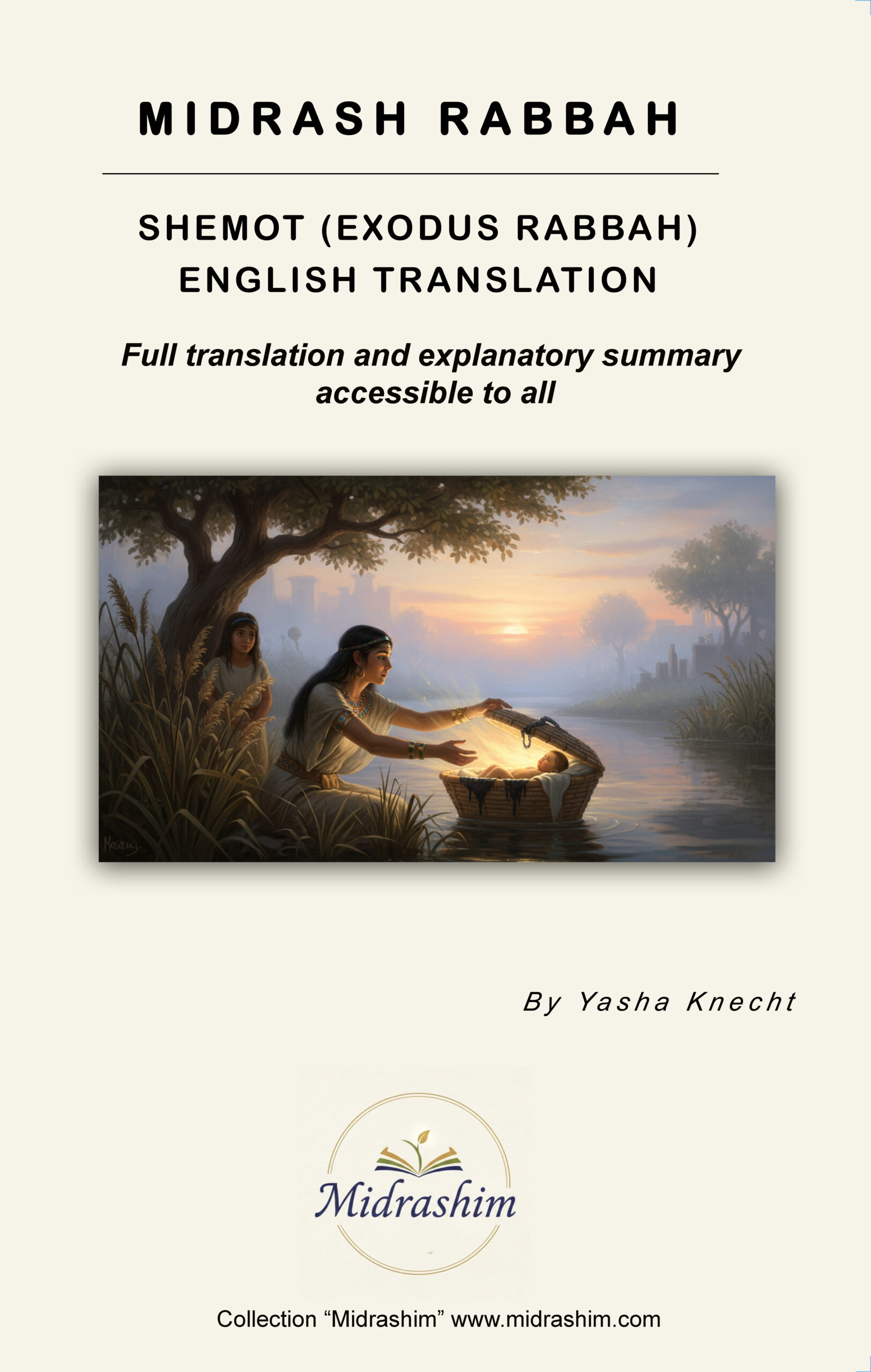
8. The Birth and Rescue of Moses
Pharaoh extended his decree to cast all sons into the river including Egyptians based on astrologers’ warning that a savior had been conceived who would be punished by water. This prophecy was ironically fulfilled by Moses’ sin at the Waters of Meribah, not by drowning. Amram, complying with his daughter Miriam’s prophecy, remarried Yocheved, who was miraculously rejuvenated at age 130. Moses was born painless, circumcised, and filled the house with light. When Yocheved could no longer hide him, she placed him in an ark made of bulrushes to avoid the smell of pitch, placing it at the river’s edge. Miriam watched from afar to see the outcome of her prophecy. Pharaoh’s daughter, bathing to cleanse herself of idolatry, found the ark. Her arm miraculously extended, or she was healed of leprosy upon touching it. Recognizing the child as a Hebrew because he was circumcised, she pitied him. Moses refused to nurse from Egyptian women to preserve his purity for future prophecy, leading Miriam to arrange for Yocheved to nurse her own son.
And the Holy One, blessed be He, said: “Wicked one! He who gave this advice is a fool. You should have killed the females! If there are no females, where will the males take wives?”
The text begins by analyzing Pharaoh’s decree to the Hebrew midwives. The command to kill upon the “obnayim” (birthstool) is interpreted variously as a reference to the hardening of the mother’s limbs like stones, the anatomy of birth resembling a potter’s anvil, or a sign regarding the gender of the child. The midwives, identified as fearing God, not only refused to kill the infants but actively sustained them with food and prayer, ensuring even those with potential defects were born whole. They justified the survival of the babies to Pharaoh by claiming Hebrew women were “vigorous” like beasts of the field, not requiring midwifery. God rewarded the midwives with “houses”—interpreted as dynasties of Priesthood/Levites (from Yocheved/Moses/Aaron) and Kingship (from Miriam). The text elaborates significantly on Miriam’s lineage, identifying her as “Ephrath” and “Azubah,” the wife of Caleb. Her various names reflect her life’s events: being “abandoned” due to illness and then “restored” to youth and beauty, eventually becoming the ancestress of King David.
“And it came to pass, because the midwives feared God, that He made them houses”: Rav and Levi discussed this. One said: Houses of Priesthood and Houses of Levites. And the other said: Houses of Kingship. Priesthood and Levites from Moses and Aaron; Kingship from Miriam, because David came from Miriam. As it is written (1 Chronicles 2:18): “And Caleb the son of Hezron begot children of Azubah his wife and of Jerioth…” Azubah is Miriam. Why was she called Azubah? Because everyone had abandoned (azavuha) her. “He begot,” but was she not his wife? Rabbi Yohanan said: This teaches you that whoever marries a woman for the sake of Heaven, the verse accounts it to him as if he had sired her. “Jerioth”: because her face was like curtains (jerioth). “And these are her sons (baneiha)”: do not read “her sons” but “her builders” (boneiha). “Jesher,” that is Caleb, who straightened (yisher) himself. “Shobab,” who turned back. “Ardon,” who subdued (radah) his inclination. “And Azubah died”: this teaches that she fell ill and was treated as if dead, and Caleb abandoned her. “And Caleb took unto him Ephrath”: this is Miriam. Why was she called Ephrath? Because Israel multiplied (paru) through her. “And he took unto him”: after she was healed, he performed the act of marriage with her again and sat her in a palanquin out of great joy.
And so you find in another place that Miriam is called by two names based on the events that occurred to her (1 Chronicles 4:5): “And Ashhur the father of Tekoa had two wives, Helah and Naarah.” Ashhur is Caleb, for he was the son of Hezron; and why was he called Ashhur? Because his face blackened (hishiru) from fasts. “Father”: for he became like a father to her. “Tekoa”: for he fixed (taka) his heart to his Father in Heaven. “Had two wives”: she was like two wives. “Helah and Naarah”: she was not two, but was Miriam alone. Why these names? Because she was sick (haltah) and then was shaken (ninaarah) from her illness, and the Holy One, blessed be He, restored her to her youth (naarut). “And Naarah bore him”: after she was healed. “Zereth, Zohar, and Ethnan”: Zereth, because she became a rival (tzarah) to her companions in beauty. Zohar, because her face was like the noonday (tzohorayim). Ethnan, because whoever saw her would bring a gift (etnan) to his wife. Therefore it is written: “And Caleb took unto him Ephrath and she bore him Hur.” And whence do we know that David came from Miriam? As it is written (1 Samuel 17:12): “And David was the son of that Ephrathite man.”
In another place it says: “And Koz begot Anub.” Koz is Caleb, who cut down (katzat) the counsel of the spies. “Anub,” he gathered good deeds at the time of the cluster of grapes (anavim). “Hazzobebah,” for he did the will (tzivyono) of the Holy One, blessed be He. “And the families of Acharhel the son of Harum”: Acharhel is Miriam, because “all the women went out after her (achareiha).” “Families”: he merited to establish families from her. “Son of Harum”: she merited that David should come from her, whom the Holy One, blessed be He, exalted (rimem) in his kingdom.
9. Moses’ Youth, Flight, and Marriage
Moses grew up in Pharaoh’s palace, where he precociously removed Pharaoh’s crown. To test if this was an act of rebellion, Jethro suggested a test with gold and a hot coal. Gabriel guided Moses’ hand to the coal, which he placed in his mouth, resulting in his speech impediment but saving his life. Upon reaching adulthood, Moses went out to his brethren and killed an Egyptian taskmaster who had assaulted an Israelite woman, using the Divine Name. Betrayed by Dathan and Abiram, Moses fled execution—during which his neck miraculously hardened like ivory—and arrived in Midian. There, he defended Jethro’s daughters at the well. Jethro, an excommunicated priest who rejected idolatry, recognized Moses’ special nature when the well water rose toward him. Moses swore an oath (Vayoel) to Jethro and married Zipporah, naming their son Gershom to mark his status as a stranger.
“And Pharaoh charged all his people”: Rabbi Yose son of Rabbi Hanina said: He even decreed against his own people. Why did he do this? Because his astrologers told him: “The savior of Israel has been conceived, but we do not know if he is an Israelite or an Egyptian.” At that moment, Pharaoh gathered all the Egyptians and said to them: “Lend me your sons for nine months that I may cast them into the River.” This is why it is written: “Every son that is born, ye shall cast into the river”; it does not say “every son of Israel,” but “every son,” whether Jew or Egyptian. But they refused to accept this, saying: “An Egyptian son will never redeem them; the savior must be from the Hebrews.”
“Into the river ye shall cast him”: Why did they decree to cast them into the river? Because the astrologers saw that the savior of Israel would be stricken by means of water, and they thought he would drown. But it was only because of a well of water (Meribah) that the death sentence was decreed upon him, as it is said: “Because ye believed not in Me.” The Sages say they took deep counsel so that the Holy One, blessed be He, would not punish them with water, for they knew that He pays “measure for measure,” and they were certain He would not bring another flood upon the world. Therefore, they decreed to drown them in water.
“And every daughter ye shall save alive”: Why did Pharaoh need to keep the females? They said: “Let us kill the males and take the females for wives,” for the Egyptians were steeped in immorality.
“And there went a man of the house of Levi”: Where did he go? Rabbi Yehuda bar Rabbi Zevina said: He went following the advice of his daughter. It is taught: Amram was the leader of the generation, etc. “And he took a daughter of Levi”: it does not say “he took her back,” but “he took.” Rabbi Yehuda bar Rabbi Zevina said: He performed a formal act of marriage; he sat her in a canopy (chuppah) while Miriam and Aaron danced before them, and the ministering angels said: “A joyful mother of children.”
“A daughter of Levi”: Is it possible she was 130 years old and called a “daughter”? Rabbi Hama bar Hanina said she was Yocheved, conceived on the way and born between the walls (entering Egypt). She is called “daughter” because, according to Rabbi Yehuda bar Zevina, signs of youth were miraculously renewed in her.
“And the woman conceived and bore a son”: Rabbi Yehuda said: Her birth is compared to her conception; just as her conception was without pain, so was her birth without pain. From here we learn that righteous women were not included in the decree of Eve. “And she saw him that he was good”: Rabbi Meir said: “Tov” (Good) was his name. Rabbi Yoshiya said: “Tuvia” was his name. Rabbi Yehuda said: He was fit for prophecy. Others say he was born circumcised. The Sages say: When Moses was born, the whole house was filled with light.
“She hid him three months”: Because the Egyptians only counted from the time he “took” her back, but she was already three months pregnant. “She could no longer hide him”: Why? Because the Egyptians would go to every house where they suspected a birth, bringing a small Egyptian baby to cry so that the Israelite baby would hear and cry with him.
“She took for him an ark of bulrushes”: Why bulrushes? Rabbi Elazar said: Because the property of the righteous is dearer to them than their bodies, so that they do not stretch their hands to robbery (rushes being inexpensive). Rabbi Samuel bar Nahman said: It is a soft material that can withstand both soft and hard conditions. “She daubed it with slime and with pitch”: slime/clay on the inside and pitch on the outside, so that the righteous child would not smell the bad odor. “She put it in the flags by the river’s brink”: Rabbi Elazar said this was the Red Sea (which reaches the Nile). Why did she cast him there? So the astrologers would think he had already been thrown into the water and would stop searching for him.
“And his sister stood afar off”: Why did Miriam stand afar? Rabbi Amram said in the name of Rav: Because Miriam used to prophesy: “My mother is destined to bear a son who will save Israel.” When Moses was born and the house filled with light, her father kissed her head and said, “My daughter, your prophecy is fulfilled.” But when they cast him into the river, her mother struck her on the head, saying, “My daughter, where is your prophecy now?” Therefore, she stood afar to see what would be the end of her prophecy.
“To wash herself at the river”: To cleanse herself from the idols of her father’s house. “And her maidens walked”: Rabbi Yohanan said “walking” here implies death (they were struck down). They said to her: “Our mistress, it is the way of the world that when a king decrees, even if the world does not keep it, his children do, yet you transgress your father’s command!” Immediately Gabriel came and smote them to the ground. “And she sent her handmaid (Amatah)”: Rabbi Yehuda and Rabbi Nehemiah disagree; one says “her hand” and one says “her servant.” The one who says “her hand” points to the word Amatah (which also means a cubit/forearm). Her arm miraculously grew. The Sages say the daughter of Pharaoh was a leper, and when she touched the ark, she was healed; therefore, she had great compassion for Moses.
“And she opened it and saw him”: Rabbi Yose bar Hanina said: She saw the Divine Presence (Shekhinah) with him. “And behold, the babe (na’ar) wept”: He is called a child (yeled) and then a youth (na’ar). Rabbi Yehuda said: He was a child but his voice was like a youth’s. Rabbi Nehemiah said: This makes Moses appear blemished; rather, his mother had made a youth’s wedding canopy for him in the ark. Gabriel struck Moses so he would cry and arouse her mercy.
“This is one of the Hebrews’ children”: How did she know? Rabbi Yose bar Hanina said: She saw he was circumcised. “This” (Zeh): She meant “This one falls into the river, but no other,” for once Moses was cast in, the decree was annulled. The astrologers saw that the savior was “judged by water” and told Pharaoh to stop the decree, not knowing he would later be punished at the “Waters of Strife“ (Meribah).
“Moses said to Israel: Because of me you were all saved.” Rabbi Hanina bar Papa said that day was the 21st of Nissan (Red Sea). Rabbi Aha said it was the 6th of Sivan (Torah).
“Then said his sister to Pharaoh’s daughter…”: Moses refused to nurse from Egyptian women. God said: “Shall the mouth that is destined to speak with Me nurse from something impure?” Furthermore, God did not want the Egyptians to say: “I nursed the one who speaks with the Shekhinah.” “The maiden (Almah) went”: She went with alacrity (Zirizut). Pharaoh’s daughter said: “Take this child” (Heiliki), prophesying unknowingly “She-liki“ (What is yours). Yocheved received a reward for nursing her own son.
“And the child grew”: He was nursed for 24 months but grew unnaturally fast. Pharaoh’s daughter loved him as her own. Pharaoh would kiss him, and Moses would take the crown from Pharaoh’s head and place it on his own. The magicians were frightened and advised killing him. Jethro suggested testing him with gold and a burning coal. Gabriel pushed his hand toward the coal; Moses put it in his mouth, burnt his tongue, and thus became “heavy of mouth and heavy of tongue.” Though Moses had many names, God only used the name Batya gave him: Moses.
“Moses was grown and went out unto his brethren”: He was 20 or 40 years old. He saw their burdens and wept, helping them carry their loads. God said: “You left your own affairs to see the sorrow of Israel; I will leave the upper and lower worlds to speak with you.” Moses also secured the Sabbath rest for them.
“He spied an Egyptian”: He saw through the Holy Spirit that an Egyptian taskmaster had forced himself upon the wife of an Israelite (Shlomit bat Divri). Moses saw what the Egyptian did in the house and what he intended to do to the husband. He killed him using the Divine Name. The next day, he saw Dathan and Abiram fighting. He said to the wicked one: “Why do you smite your fellow?” (Even lifting a hand to strike makes one “wicked“). They informed on him. Pharaoh tried to execute Moses, but his neck became like a pillar of ivory. Moses fled miraculously as an angel took his place or the guards were struck dumb and blind.
“He sat down by a well”: Following the path of the Patriarchs. Jethro (Reuel) had been a priest of idols but realized they were nothing. He was excommunicated by his town, and thus his daughters had to tend the sheep. Moses saved them from the shepherds who had harassed them. They told their father: “An Egyptian delivered us,” because of his clothes. Jethro realized he was a descendant of Jacob because the water of the well rose toward him. Zipporah ran like a bird to bring him in, and Moses married her.
“And Moses was content” (Vayoel): Rabbi Yehuda says this means he swore to him, for Vayoel signifies nothing other than an oath, as it is said (I Samuel 14:24): “And Saul adjured (Vayoël) the people.” Why did he make him swear? He [Jethro] said: “I know that your forefather Jacob, when Laban gave him his daughters, took them and left without his knowledge; perhaps if I give you my daughter, you will do the same to me.” Immediately he swore to him, and he gave him Zipporah. Rabbi Nehemiah said: He agreed to lodge with him, for Vayoel signifies lodging, as it is said (Judges 19:6): “Be content (Hoël), I pray thee, and tarry all night.” Our Sages of blessed memory said: He took it upon himself to shepherd his flock, and Vayoel signifies a beginning: as soon as he married his daughter, he began and accepted to shepherd his flock. “And she bore a son, and he called his name Gershom”: it is the way of the righteous to name their children according to the event. Regarding Joseph, what does it say? (Genesis 41:51-52): “And Joseph called the name of the firstborn Manasseh… and the name of the second he called Ephraim,” in order to remember the miracles the Holy One, blessed be He, had performed for him. So too, Moses named his son Gershom because of the miracle God performed for him, for he was a stranger (Ger) in a foreign land and the Holy One, blessed be He, made him prosper there.
“And it came to pass in the course of those many days”: these were days of sorrow, therefore they are called “many” (long). Similarly (Leviticus 15:25): “And if a woman has an issue of her blood many days,” because they were days of sorrow, they are called “many.” “And the king of Egypt died”: meaning he was struck with leprosy, and the leper is considered as dead, as it is said (Numbers 12:12): “Let her not, I pray, be as one dead,” and it says (Isaiah 6:1): “In the year that King Uzziah died.” “And the children of Israel groaned”: why did they groan? Because the magicians of Egypt said [to Pharaoh]: “You have no cure unless we slaughter one hundred and fifty Israelite children in the evening and one hundred and fifty in the morning, and you bathe in their blood twice a day.” As soon as Israel heard this harsh decree, they began groaning and lamenting. “And they cried out” (Vayiz’aqu) is a term of lamentation, as it is written (Ezekiel 21:17): “Cry (Ze’aq) and howl, son of man.” “And their cry (Shav’atam) came up to God”: it does not say “their shout,” but their plea, as you say (Job 24:12): “And the soul of the wounded cries out (Teshavé’a).” “And God heard their groaning” (Naaqatam): the groaning of the wounded, as you say (Ezekiel 30:24): “And he shall groan with the groanings (Naaqot) of a wounded man,” and (Job 24:12): “From out of the city, the dying groan.” “And God remembered His covenant”: Israel did not deserve to be saved because they were wicked, but they were redeemed through the merit of the fathers. Thus it is written: “And God remembered His covenant.” Our Sages of blessed memory said: a miracle happened for them and he was healed of his leprosy.
“And God saw the children of Israel,” as it is said (Exodus 3:7): “I have surely seen the affliction of My people.” “And God knew” (Exodus 3:7): “For I know their pains.” Another explanation: “And God saw” that they had no good deeds by which they could be redeemed. Thus it is explained through Ezekiel (16:7): “I have caused thee to multiply as the bud of the field…”. It should only have said “thy hair was grown” and then “thy breasts were fashioned,” for the lower sign usually comes before the upper one. But what is “thy breasts were fashioned”? This refers to Moses and Aaron who were ready to redeem them, as it is written (Song of Songs 4:5): “Thy two breasts are like two fawns.” “Thy hair was grown”: the end-time of redemption had arrived. “But thou wast naked and bare”: without good deeds. Therefore it says: “And God saw,” for they had no deeds by which to be redeemed.
10. The Cry of Israel and Divine Remembrance
The narrative shifts to the intense suffering of the Israelites. The “death” of the King of Egypt is interpreted as him being stricken with leprosy, leading to a horrific decree to bathe in the blood of Israelite children. The Israelites’ reaction is described through various terms for crying (Vayiz’aqu, Shav’atam, Naaqatam), reflecting different depths of pain and prayer. God “remembered” the covenant not because of the people’s current righteousness—they are described as “naked” of good deeds—but due to the merit of the Patriarchs and the future acceptance of the Torah. The phrases “God saw” and “God knew” are analyzed deeply: God saw their future failings (the Golden Calf) but also knew the hidden thoughts of repentance in their hearts. Ultimately, redemption was set in motion through the combination of ancestral merit and the “blood of the covenant” (circumcision and the Paschal lamb).
“And God saw the children of Israel and God knew”: the Holy One, blessed be He, knew that He must redeem them for His name’s sake because of the covenant He made with the fathers. Thus it says (Exodus 2:24): “And God remembered His covenant,” and so it says through Ezekiel (20:9): “But I wrought for My name’s sake.” Another explanation: “And God saw”: Reish Lakish said, He saw that they were destined to rebel at the Red Sea, as it is written (Psalms 106:7): “They rebelled at the sea, even at the Red Sea.” “And God knew”: He knew they were destined to say (Exodus 15:2): “This is my God.” Rabbi Joshua ben Levi said: He saw they were destined to say (Exodus 32:4): “These are thy gods, O Israel.” “And God knew”: that they were destined to prioritize “we will do” over “we will hear.” And the Rabbis say: “And God saw” that the intermediate ones repented, and even the wicked thought of repenting, as it is written (Song of Songs 2:13): “The fig tree putteth forth her green figs.” “And God knew”: that even one towards his fellow did not know, but the Holy One, blessed be He, alone knew that this one directed his heart and that one directed his heart and they repented. And even though they repented, they would not have gone out from there were it not for the merit of the fathers, because the Attribute of Justice was accusing them for the Calf they were destined to make. Regarding this, it is said (Exodus 12:22): “And ye shall take a bunch of hyssop,” corresponding to their humbling themselves to repent like the hyssop. “And dip it in the blood that is in the basin (Saph)”: by the merit of the Torah they were destined to receive, as it is written at the giving of the Torah (Exodus 24:8): “And Moses took the blood.” “And strike the lintel”: for Abraham was the greatest of converts, and just as the lintel is high, so was he the greatest of the patriarchs. “And the two side posts”: by the merit of Isaac and Jacob. This teaches you that through the merit of all these they went out. Another explanation: “And God saw” the abstinence between them. “And God knew” that the time He spoke of to Abraham was near, and He revealed Himself to Moses to inform him while he was a shepherd.
Table des matières complète par sujet
Table des matières …………………………………………………………….. 3
Introduction générale …………………………………………………………. 6
Introduction historique et philosophique du Midrash …………. 6
Message aux lecteurs juifs …………………………………………………… 7
Renforcement de l’identité juive …………………………………… 8
Instruction religieuse et morale ……………………………………. 8
Transmission de la tradition et du savoir ……………………….. 9
Encouragement spirituel et théologique ………………………… 9
Invitation à la réflexion et à la responsabilité ……………….. 10
Message aux lecteurs chrétiens ………………………………… 11
Le midrash est pour un Chrétien …………………………………. 11
Message aux lecteurs musulmans ……………………………… 13
Changer l’angle : du contenu à la forme ………………………. 13
Qu’est-ce que le style midrashique ? …………………………… 14
Le Coran fonctionne de la même manière ……………………. 14
Différence avec la Bible écrite …………………………………….. 14
Conclusion ……………………………………………………………….. 15
Vision tournée vers l’avenir ………………………………………… 16
Message au lecteur laïc …………………………………………….. 16
Dimension narrative et symbolique …………………………….. 17
Exploration des valeurs humaines universelles ……………. 17
Style suggestif et réflexif …………………………………………… 18
Dimension culturelle et historique ………………………………. 18
Valeur philosophique et spirituelle laïque ……………………. 19
Table of Contents
General Introduction Midrash Shemot Rabbah – Exodus Rabbah 4
Message to Christian Readers. 6
Message to the Secular Reader 11
MIDRASH EXODUS RABBAH – PARASHA SHEMOT_ 14
- The Vital Role of Discipline. 14
- Prophetic Symbolism of the Tribes’ Names. 19
- The Death of Joseph and Miraculous Growth. 21
- The New King’s Counsel and Betrayal 22
- The Nature of the Egyptian Oppression. 23
- Righteous Women and the Midwives. 26
- The Birth and Rescue of Moses. 31
- Moses’ Youth, Flight, and Marriage. 34
- The Cry of Israel and Divine Remembrance. 41
- The Revelation of Divine Attributes. 44
- The Shekhinah and the Divine Test. 45
- The Test of Shepherding. 46
- Predestination and the Significance of the Wilderness. 48
- The Holy Mountain and Divine Empathy. 50
- Symbolism of the Burning Bush. 52
- The Calling and Consecration of Moses. 54
- The Gentle Revelation and Moses’ Reaction. 57
- Divine Foreknowledge and Judgment in the Present. 60
- Moses’ Objections and the Merit of Redemption. 61
- The Divine Names and Attributes. 64
- The Strategy and Code of Redemption. 66
- Forewarning of Pharaoh’s Resistance. 67
- Moses’ Slander and the Sign of the Serpent. 68
- Symbolism of the Rod and Pharaoh’s Defeat. 70
- The Third Sign: Water Turning to Blood. 72
- Divine Empowerment of Speech. 73
- Deferring to Aaron or Angels. 73
- The Rod of Discipline. 75
- Moses as the Righteous Man of Psalm 24. 76
- The Merit of Jethro and the Obligation of Gratitude. 77
- The Irresistibility of the Divine Decree. 78
- Resolving the Timeline and the Departure of Moses’s Family. 79
- The Reunion of Aaron and Moses. 81
- Moses’s Upbringing and the Definition of “Dead” Men. 82
- The Incident at the Inn. 84
- The Characteristics of the Divine Voice. 86
- Cosmic Sounds and the Meeting of Virtues. 87
- The Role of Elders and the Secret Code. 90
- The Disappearance of the Elders. 92
- Pharaoh’s Reception and the Search for God’s Name. 92
- The Parable of the Cemetery and the Living God. 93
- Showing Respect to the Monarchy. 95
- The Multitude of Israel and the Remnant. 96
- The Suffering and Reward of the Israelite Officers. 98
- Moses Challenges God’s Justice. 99
MIDRASH RABBAH – PARASHA VAERA_ 102
- The Limits of Human Wisdom: Solomon and Moses. 102
- The Burden of Leadership and the Shift from Justice to Mercy. 104
- The Parable of the Intermediary. 106
- The Faith of the Patriarchs vs. The Impatience of Moses. 106
- The Four Expressions of Redemption and the Adherence to Idolatry 107
- The Cost of Idle Words: Joseph’s Example. 109
- Moses’ Reluctance and Aaron’s Inclusion. 109
- The Three Refusals. 110
- The Burden of Leading a Difficult People. 111
- The Parable of the Orchard: The Role of the Wicked. 112
- Lineage and Marriage Lessons. 113
- Solomon, the Ark, and the Merit of David. 114
- The Divine Attributes Shared with Humanity. 115
- The Four Men Who Claimed Divinity. 116
- Divine Justice Against Arrogance. 118
- The Rod of Sapphire and Aaron’s Role. 119
- Divine Foreknowledge and the Desire for Righteousness. 121
- The Request for Signs: From Righteous to Wicked. 122
- The Staff as a Tool for Chastisement. 123
- Symbolism of the Serpent and the Sea Monster. 124
- The Protocol of Moses and Aaron Entering the Court. 125
- Pharaoh’s Mockery and the Sorcery of Egypt. 125
- The Miracle of the Swallowing Staff 127
- Confronting the Self-Proclaimed Deity at the Nile. 128
- The Plague of Blood: Gratitude and Justice. 129
- The Miraculous Separation of Water and Blood. 130
- Sorcery, Demons, and the Search for Water. 131
- The Duration of Warning and Plague. 132
- Eschatological Parallels: Egypt and Rome. 133
- The Divine Purpose of “Superfluous” Creatures. 134
- The Dual Nature of the Plague: Smite and Pestilence. 135
- Frogs as Peacemakers and Royal Punishers. 135
- Self-Sacrifice in the Ovens. 136
- Divine Ownership of the Nile. 137
- Gratitude to the Water and the Origin of the Frogs. 138
- The Torment of Noise and the Stench of Death. 139
- The Plague of Lice and Gratitude to the Dust. 140
- The Failure of the Magicians. 140
- Moses’ Diligence and Pharaoh’s Evasion. 142
- The Plague of the Swarm (Arov) 144
- The Plague of Pestilence (Dever) 145
- Miracles of the Boils (Shchin) 146
- Hardening Pharaoh’s Heart. 147
- God as Teacher of Repentance. 149
- The Warning of Hail and Divine Mercy. 150
- Dominion Over Heaven and Earth; Fire within Hail 151
- The Aftermath of Hail and Pharaoh’s Relapse. 154
MIDRASH RABBAH – PARASHA BO_ 156
- The Creation of Earth and Divine Patience. 156
- Israel as the Stone and Sand. 157
- Divine Justice and the Hardening of the Heart. 158
- The Warning of the Locusts. 159
- Pharaoh’s Refusal to Release the Children. 160
- Retribution Through Locusts. 160
- The Nature and Origin of the Darkness. 162
- Concealing the Death of Sinful Israelites. 163
- The Intensity of Darkness and Israel’s Integrity. 164
- Divine Light and the Final Rupture. 165
- Springtime Redemption and the Identity of the “Flowers”. 167
- The Convergence of “Firsts” in the Month of Nissan. 168
- Israel’s Authority Over the Calendar. 169
- Redemption Through the Merit of Moses and Aaron. 170
- Leaping Over Mountains: The Merit of the Patriarchs and Elders. 171
- God’s Descent into Impurity to Rescue Israel 172
- Faithfulness During the Four Exiles. 173
- The Patriarchs as the Foundation of the World. 176
- Israel’s Unique Isolation and Divine Protection. 177
- Marking a New Era of Freedom… 178
- Symbolism of the Passover Offering. 179
- Inaugurating the Divine Kingdom… 180
- Divine Promise vs. Human Leadership. 181
- The Merit and Role of the Elders in Redemption. 203
- Prohibition of Healing Through Sinful Acts. 204
- The Futility of Idolatry Versus the Power of God. 206
- Renouncing Idolatry as a Prerequisite for Passover. 207
- The Public Slaughter of Egyptian Gods. 208
- Divine Reciprocity: Moses and Samuel 209
- Measure for Measure: Judah and the Egyptian Feast. 210
- Creation Declares God’s Glory. 212
- The Greatness of the Lowly. 214
- The Three Postures of Divine Judgment. 215
- Divine Warfare and Israel’s Redemption. 216
- Confirming the Servant’s Word. 218
- The Covenant of Midnight. 219
- Distinguishing the Righteous at Midnight. 220
- The Lamp That Does Not Go Out. 221
- Pharaoh’s Midnight Panic. 222
- Breaking the Enemy at Night. 222
- The Miracle of Hezekiah’s Passover. 224
- The Heavenly Advocate. 226
- The Strategic Progression of Plagues. 226
- Measure for Measure at Midnight. 229
- The Victorious Departure. 230
- The Primacy of the Heart in Joy and Sorrow.. 233
- David’s Prayer for Integrity Against the Evil Inclination. 235
- Moses’s Three Deductions Approved by God. 236
- The Divine Acceptance and Future Reward of Proselytes. 237
- The Argument for Accepting Sincere Converts over Deceitful Ones 239
- The Contrast Between the Hasty Exodus and the Future Redemption 241
- Sanctification of the Firstborn and the Memorial of Redemption. 242
- Parables of Eternal Gratitude and Remembrance. 243
MIDRASH RABBAH – PARASHA BECHALLACH_ 245
- The Whip and the Bridle: Pharaoh and Abimelech. 245
- The Parable of the Shepherd and the Stolen Ewe. 246
- The Rod of Boils and Pharaoh’s Regret. 248
- The Sold Orchard: Realizing Israel’s Value. 249
- The King’s Decree: Whose Word Stands?. 250
- Measure for Measure: The Fate of Pharaoh’s Children. 250
- From a Mound of Stones to an Orchard of Pomegranates. 251
- The Escaped Bird: Fleeing the Serpent. 252
- The Host’s Lament: Losing Divine Proximity. 253
- The Wedding Attendant’s Sorrow.. 254
- The Unrecognized Wealth: The Bundle of Pearls. 255
- The Reversal of Enemies: Forced Acknowledgement. 256
- Reversing the Way of the World: God Serving Israel 257
- The Premature Exodus of the Tribe of Ephraim… 258
- No Comfort Without Justice. 259
- The Reason for the Delay: Parables of Inheritance. 260
- Strategic Delays: Replanting and Reputation. 261
- The Protective Detour: Avoiding the Slaughterhouse. 261
- The Obligation to Recline. 262
- The Wise of Heart: Moses and Joseph’s Bones. 263
- The Double Oath and the Return to Shechem… 264
- The Inheritance of Prayer. 265
- Divine Foreknowledge and the Power of Decree. 266
- The Equality and Unity of Collective Prayer. 266
- The Purpose of Peril: A Dove in the Clefts. 267
- The Pre-Ordained Condition of the Sea. 267
- The Sea’s Resistance and Submission. 268
- Distracting the Accuser with Job. 269
- Action Over Prayer. 271
- Ancestral Merit and the Staff 272
- Faith in the Depths. 272
- God’s Glory Through Pharaoh’s Defeat. 273
- The Cunning of the Egyptians and the Judgment by Water. 275
- The Persecution of Children and the Principle of Measure for Measure 276
- The Mechanics of Salvation and the Parable of the Two Hands. 277
- The Centrality of Faith and the Obligation to Remember the Sea. 278
- The Necessity of Clean Hands for Pure Prayer. 279
- Establishing God’s Kingship Through Song. 280
- Song as an Expression of Faith. 281
- Rectifying Complaint with Praise. 281
- Israel’s Unique Capacity for Song. 283
- Exile, Redemption, and the Song of Faith. 285
- Singing of God’s Mercy in the Morning. 286
- Israel’s Precedence Over the Angels. 287
- The Infants Recognized God. 288
- The Calculation of Divine Plagues. 290
- The Dual Nature of Israel and the Song. 291
- Purity and the Covenant of Circumcision. 292
- Divine Hierarchy and Exaltation. 293
- The Downfall of the Horse and Rider. 294
- Visual Revelation of the Divine. 295
- Ingratitude Despite Divine Miracles. 296
- The Nature of the Rebellion at the Sea. 297
- The Foolishness of Challenging the Almighty. 298
- The Unnoticed Miracles of the Body. 298
- Escaping the Wrath of the Prince of the Sea. 299
- The Debate Over Returning to Egypt. 299
- Reluctance and the Removal of Idolatry. 300
- The Metaphor of the Sheep. 301
- Interpretations of the Wilderness of Shur. 302
- God’s Heavenly Treasury. 304
- The God of Hosts and His Agents. 305
- Divine Generosity and the Manna’s Taste. 306
- Divine Mercy Despite Murmuring. 307
- The Merit of Abraham… 308
- The Unique Works of God vs. Humans. 309
- Bread of Torah and the Lack of Song. 311
- A Table in the Wilderness. 312
- Exaltation from Dust to Heights. 313
- The Heavenly Banquet and King David’s Blessing. 314
- The Parable of the Bird and Repentance. 315
- Spiritual Bread and the Vision of Beauty. 316
- Daily Sustenance and Testing. 317
- The Rebellion of Dathan and Abiram… 318
- The Sabbath as a Special Gift. 319
- The Redemptive Power of the Sabbath. 319
- Amalek and the Sequence of Tribulations. 321
- The Crisis of Thirst Preceding the Attack. 321
- Divine Instruction on Leadership and the Rod of Blessing. 322
- The Conditional Faith at Massah and Meribah. 323
- The Parable of the Child on the Father’s Shoulders. 324
- The Selection of Joshua for Battle. 324
- The Soldiers and the Divine Rod. 325
MIDRASH RABBAH – PARASHA YITHRO_ 327
- Jethro as the Faithful Friend versus Familial Betrayal 327
- The Merit of Jethro Against the Wickedness of Esau. 327
- Jethro’s Honorable Arrival and Conversion. 328
- Balaam’s Involuntary Praise of Jethro. 329
- The Nations Drawing Near to God. 330
- The Open Door for the Convert. 331
- Repentance Inspired by Divine Judgment. 331
- The Reciprocity of Jethro and Moses. 333
- The Seven Names of Jethro. 333
- The Burden of Leadership and Mutual Responsibility. 334
- The Parable of the Two Cups. 336
- Salvation Through Hearing. 337
- Moses Capturing the Torah on High. 338
- The Order of Instruction at Sinai 338
- The Sanctification of the People. 339
- The Omnipotence of Divine Speech. 340
- The Universal Scope of the Revelation. 342
- The Unity of God’s Voice and the Refutation of Heresy. 344
- Divine Distinction Among Myriads of Angels. 345
- Redemption as the Foundation for Divine Acceptance. 345
- The Lethality of Revelation and the Torah’s Intercession. 346
- God’s Solitary Existence Versus Human Lineage. 347
- God’s Role in the Exodus Narrative. 347
- The Creator Who Prepares His Own Dwelling. 348
- God Sustaining Humanity Throughout History. 349
- Divine Solitude in War Versus Multitudes in Revelation. 349
- The Awesome Fear of God’s Judgement. 350
- The Hierarchy of Fear: Israel and the Nations. 351
- Divine Roaring Over the Prosperity of Idolaters. 352
- The Metaphor of the Lion in Destruction and Exile. 352
- Universal Silence During the Giving of the Torah. 353
- Divine Strength and the Love of Justice. 354
- Divine Patience and the Timing of Judgment. 355
- The Altar Steps and Judicial Conduct. 356
- The Grammar of “And These” vs. “These”. 357
- The Torah Surrounded by Justice. 359
- The Three Loves of Moses. 359
- Divine Warnings and Historical Allusions. 360
- The Preciousness of Israel and Detail of the Law.. 362
- The Logic of Restitution for Theft. 362
- The Protector of Orphans and Widows. 363
- God as the Exemplar of His Laws. 364
- The Exclusive Gift of Torah to Israel 365
- Moses’ Authority and the Appointment of Judges. 366
- The Protection of Legal Knowledge. 367
MIDRASH RABBAH – PARASHA MISHPATIM_ 377
- The Two Paths of Divine Law.. 377
- The Severity of Immorality Compared to Idolatry. 378
- Divine Restrictions as a Sign of Life. 379
- The Condition of Torah and Judicial Integrity. 380
- The Power of Charity and Hope for Salvation. 381
- The Concealed Value of Commandments. 382
- Divine Forgiveness and the Creditor. 382
- The Trials of Wealth and Poverty. 384
- The Prohibition and Peril of Usury. 385
- Respect for Judges and the Order of Tithes. 387
- Holiness and the Reward of the Dogs. 388
- The Temple as a Pledge for Israel’s Sins. 389
- The Ultimate Destination of Usurious Wealth. 390
- The Agony of Poverty and Divine Solidarity. 391
- The Prohibition of Usury as a Grave Sin. 392
- The Wheel of Fortune and the Merit of Charity. 392
- Obligations Regarding Pledges and Laborers. 394
- Reverence for Judges and the Consequence of Disrespect. 394
- The Temple as a Pledge for Redemption. 396
- Recapitulation: The Wickedness of Usury and the Plight of the Poor 397
- Recapitulation: The Divine View of the Destitute. 399
- Cosmic Harmony: Nature’s Mutual Lending. 400
- Divine Generosity vs. Human Greed. 401
- The Parable of the Corrupt Treasurer. 401
- Honor for Leaders and the Cycle of Festivals. 403
- Cain’s Greed and the Murder of Abel 404
- Ephron’s Greed Regarding the Cave of Machpelah. 405
- Esau Sells His Share in the Cave. 406
- The Stinginess of the Borrower. 407
- The Consequences of Withholding Tithes. 407
- The Fate of Wealth Gained by Usury. 408
- The Divine Reward for Lending Without Interest. 409
- The Loss of Immortality and Freedom… 411
- From Divine Presence to Angelic Intermediary. 412
- The Desirability and Metaphors of the Land. 413
- The Metaphor of Betrayal 414
- The Nature of the Angelic Messenger. 415
- Divine Protection and Final Reconciliation. 417
MIDRASH RABBAH – PARASHA TEROUMAH_ 419
- The Torah as an All-Encompassing Purchase and God’s Presence. 419
- The Torah as a Gift and Divine Habitation Among the Rebellious. 420
- Spiritual Awakening Through the Call for an Offering. 421
- Mirroring the Celestial Realm Within the Earthly Tabernacle. 422
- The Superiority of a Good Name Over Wealth: Moses, Phinehas, and Mordecai 423
- The Paradox of Selling the Torah. 426
- The Torah as Eternal Heritage and Spiritual Betrothal 427
- Divine Assistance and Jacob’s Foresight in Preparing Materials. 428
- God’s Power Adapted to Human Capacity. 430
- Contracting the Divine Presence. 431
- The Ark and the Light of Creation. 432
- The Crown of Torah Open to All 432
- The Sanctuary as a Home for the Relationship. 433
- The Primal Light Hidden for the Righteous. 435
- The Purpose and Varieties of Gold. 436
- The Use of Cedars and Preservation of Fruit Trees. 437
- Moses’ Instruction and Bezalel’s Execution. 438
- The Tabernacle as a Pledge for Atonement. 438
- Materials Representing Nations and the Exclusion of Rome. 439
- Mirroring the Celestial Court. 440
- The Symbolism of the Olive Tree for Israel 441
- Distinctiveness and Supremacy of the Olive Oil 442
- The Temple as the Source of Joy and Light. 442
- The Parable of the Blind and the Sighted. 444
- The Torah and Commandments as Spiritual Illumination. 445
- Divine Reciprocity in Service. 446
MIDRASH RABBAH – PARASHA TETSAVEH_ 448
- The Internal Selection of Leadership. 448
- Vindicating Aaron’s Role in the Golden Calf 449
- The Hierarchy of Divine Choice. 451
- The Eternity of the Divine Word. 453
- The Paradox of Holiness and Mortality. 453
- Gender Nuances and Prophetic Atonement. 454
- The High Priest as an Angelic Scholar. 455
- Words of Prayer Substituting for Sacrifice. 456
- Israel’s Divine Protection and Enemies. 457
- The Symbolism of the Twelve Stones. 457
- The Parable of the Royal Garments. 458
- Inscriptions on the Breastplate. 459
MIDRASH RABBAH – PARASHA KI-TISSA_ 461
- The Divine Rehearsal and Preparation. 461
- Knowledge Without Fear of Sin. 462
- Ancestral Merit and the Reward of Wisdom… 462
- The Book of Adam and the Appointment of Bezalel 463
- The Pre-existent Soul and Historical Visions. 464
- The Significance of Multiple Names. 465
- Equality Among the Tribes in Divine Service. 466
MIDRASH RABBAH – PARASHA VAHYAQHEL 468
- Divine Righteousness Versus Human Shame. 468
- The Benevolence of the Divine Landlord. 469
- The Paradox of the Calf and the Tablets. 471
- The Broadening Power of Gifts. 471
- The Four Divine Gifts. 472
- Wisdom and Intimacy with the Divine. 473
- The Request for Direct Revelation. 474
- The Unmatched Humility of God. 474
- The Torah as a Beloved Bride. 475
- The Empty Boast of the Wilderness Generation. 480
- Moses as Defense Attorney. 481
- A Leader’s Status Depends on His People. 483
- Excommunication and Spiritual Betrayal 483
- Divine Protection from the Angels. 486
- Divine Empathy and Foresight. 487
- The Mixed Multitude’s Culpability. 488
- The Swiftness of the Turn. 489
- The Parable of the King’s Pearls. 490
- The “Stiff-Necked” People. 492
- The Hidden Invitation to Intercede. 492
- Moses and Daniel as Defenders of Israel 494
- Parables of the King’s Judgment and Moses’ Intervention. 495
- The Wise Man Who Pacifies Divine Wrath. 496
- Sweetening the Bitterness of Judgment. 497
- Moses Annuls the Divine Vow of Destruction. 498
- The Grammatical Defense of the Commandments. 501
- Arguments of Financial Responsibility and Ironic Utility. 502
- The Environmental Influence of Egypt. 503
- The Parable of the Vine and the Merit of the Patriarchs. 507
- Praising the Dead Over the Living. 508
- The Wisdom of Delayed Reward. 509
- Balancing the Ten Commandments with Ten Trials. 510
- Specific Atonement for Specific Punishments. 511
- The Resurrection and Divine Accountability. 512
- Completing the Quorum of Ten Righteous Men. 512
- Countering the Five Angels of Destruction. 513
- Legal Arguments regarding Oaths and Covenants. 514
- God’s Capacity to Repent of Evil 517
- The Nature of Israel’s Lost Ornaments. 518
- The Divine Honor and Authority of Moses. 519
- Recalling Redemptions and the Dynamics of Divine Anger. 520
- The Sea and the Cave Metaphor. 521
- The People’s Reverence and Moses’ Return. 522
- Humility and the Vision of the Divine. 523
- The Treasuries of Goodness and Grace. 525
- Seeing is Believing. 527
- The Strategy of the Best Man. 528
- Solidarity and Double Wisdom… 528
- The Wealth of Moses. 530
- Three Initiatives of Moses. 530
- The Fair-Weather Son. 531
- The Flaw in the Clay. 532
- Familial Resemblance and Reconciliation. 534
- The True Father is the Guardian. 535
- The Distinction Between Written and Oral Torah. 537
- Reconciliation Through the Second Tablets. 538
- The Covenant and the Merit of Moses. 538
- Sustaining the Universe Through Torah Study. 540
- Moses’ Intercession and Self-Sacrifice. 541
- The Value of a Good Name. 543
- Divine Recognition and Gratitude. 544
- Reputation and Lineage in Scripture. 545
- The Martyrdom of Hur and Bezalel’s Reward. 546
- Building with Wisdom, Understanding, and Knowledge. 547
- Divine Inspiration and Healing the Sin. 549
- Atonement Through the Tabernacle Contributions. 549
- Unquenchable Love Between God and Israel 551
- Sin and Redemption: Black but Comely. 552
- Symbolic Meanings of the Tabernacle Materials. 553
- The Primacy of Light and the Ark. 554
- Bezalel’s Wisdom and the Order of Construction. 555
- Divine Healing Through the Agent of Affliction. 556
- The Structure of the Veil and Temple Artifacts. 557
- Divine Reward for Devotion and Craftsmanship. 558
MIDRASH RABBAH – PARASHA PEQOUDE_ 560
- The Faithful Steward versus The Hasty Seeker of Wealth. 560
- Protocols of Financial Accountability. 561
- Maintaining Innocence Before God and Man. 561
- The Tabernacle as a Pledge for Future Sins. 562
- Divine Reconciliation after the Golden Calf 563
- The Proxy War Against God. 564
- Moses Refutes the Gossipers. 566
- Abraham’s Choice: Exile Over Gehenna. 567
- Rectifying the Sin of “These” with “These”. 568
- The Tabernacle as a Bride. 571
- Silencing the Scoffers. 572
- Reward in the World to Come. 574
- The Miraculous Erection of the Tabernacle. 575
- The Day of Joy and Espousals. 576
- Key theological terms. 582
- Terms related to ethics and human responsibility. 582
- Specific midrashic narrative terms. 582
- Characters and titles to clarify. 583
- Terms related to exile and deliverance. 583
- Ritual or cultural terms requiring clarification. 583
- Frequent symbolic concepts. 583