A comparative reading of the biblical narrative and the Quran
Midrashic References
וַיְהִי בַדֶּרֶךְ בַּמָּלוֹן (שמות ד, כד). אָמַר רַבִּי יוֹסֵי בַּר חֲלַפְתָּא: חַס וְשָׁלוֹם שֶׁמֹּשֶׁה נִתְרַשֵּׁל בַּמִּילָה, אֶלָּא כָּךְ אָמַר: אָמוּל וְאֵצֵא לַדֶּרֶךְ סַכָּנָה הִיא לַתִּינוֹק… אַף עַל פִּי כֵן מִשֶּׁבָּא לַמָּלוֹן נִתְעַסֵּק בַּלִּינָה תְּחִלָּה עַל כֵּן ‘וַיִּפְגְּשֵׁהוּ ה’ וַיְבַקֵּשׁ הֲמִיתוֹ’. (שמות רבה ה:ח)
“And it came to pass on the way at the lodging place” (Exodus 4:24). Rabbi Yose bar Halafta said: Heaven forbid that Moses was negligent regarding circumcision ! Rather, this is what he said: ‘If I circumcise him and set out on the journey, it is a danger to the infant…’ Nevertheless, as soon as he arrived at the lodging place, he occupied himself first with staying the night. Therefore, ‘the Lord met him and sought to kill him’. (Shemot Rabbah 5:8)
תַּנְיָא רַבִּי אֱלִיעֶזֶר בֶּן יַעֲקֹב אוֹמֵר רְבִיצָא דְּמַלְאָךְ כְּנָחָשׁ בָּלַע לֵיהּ לְמֹשֶׁה מֵרֵישֵׁיהּ וְעַד מִילָתוֹ וְהָדַר בָּלַע לֵיהּ מִכַּרְעֵיהּ וְעַד מִילָתוֹ הֵבִינָה צִפּוֹרָה דְּבִשְׁבִיל מִילָה הוּא כְּתִיב וַתִּקַּח צִפֹּרָה צֹר. (תלמוד בבלי, נדרים לב ע »א / מובא במפרשי שמות רבה)
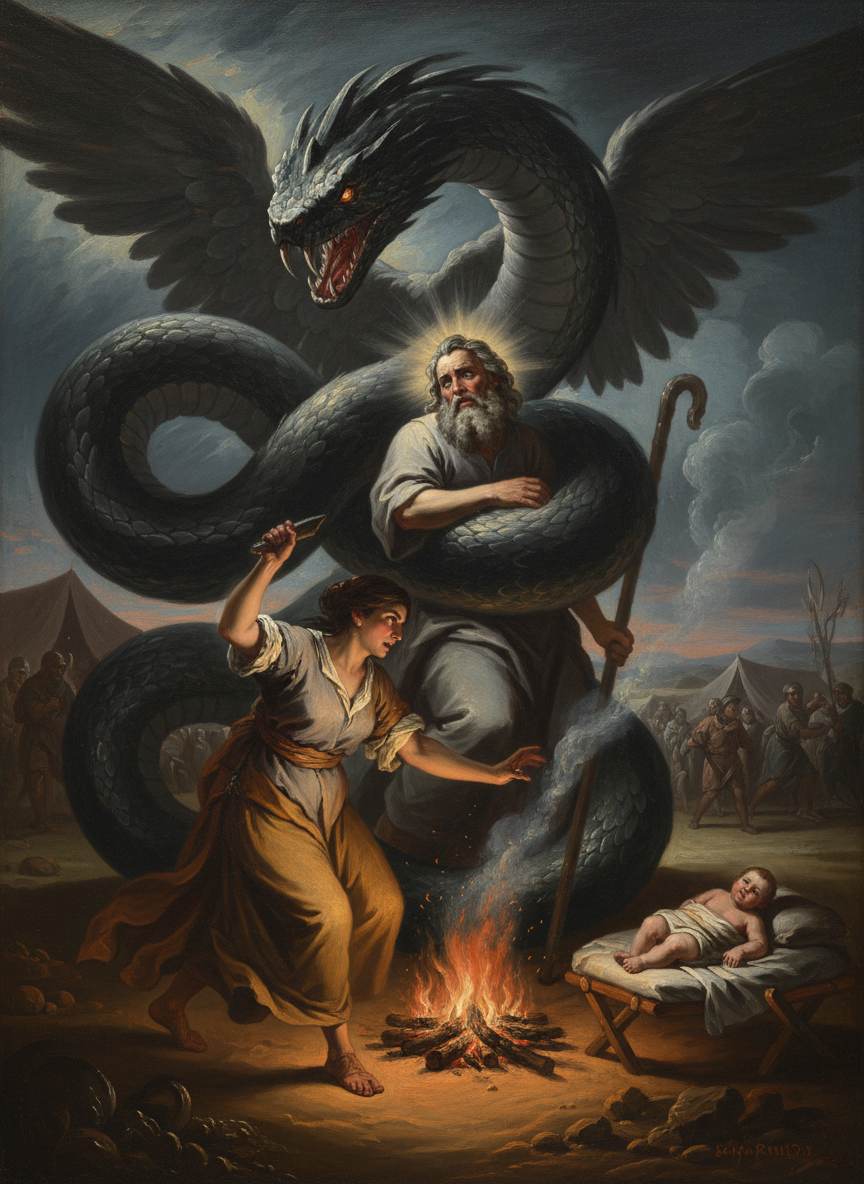
It is taught: Rabbi Eliezer ben Jacob says: The angel, in the form of a serpent, swallowed Moses from his head to the place of circumcision, and then swallowed him again from his feet to the place of circumcision. Zipporah understood that it was because of the delayed circumcision, as it is written: ‘Zipporah took a sharp stone’. (Babylonian Talmud, Nedarim 32a)
🕊️ Moses between Covenant and Prophecy
Moses is one of the most structuring figures in world religious history. The central Prophet of Judaism and a major reference in Islam, he embodies liberation, the Law, and moral responsibility. However, the way his mission is understood differs profoundly according to the traditions.
The Book of Exodus does not only tell of a heroic vocation. It introduces a fundamental tension between divine call, covenant, and personal requirement, which reaches its climax in a passage as brief as it is disturbing.
📖 (Exodus 4:24–26)
24 During the journey, at a place where Moses spent the night, the Lord attacked him and sought to kill him.
25 Zipporah took a sharp stone, cut off her son’s foreskin, and threw it at Moses’ feet, saying: You are a husband of blood to me!
26 And the Lord let him go. It was then that she said: Husband of blood! because of the circumcision.
🔥 Moses in the Torah: a chosen one under condition
In the Torah, Moses is never idealized. He is chosen, but without being sanctified beyond reproach. He hesitates, argues, and sometimes makes mistakes.
At the precise moment he sets out to accomplish his mission, the text states that God « seeks to kill him » ((Exodus 4:24–26)). The rabbinic tradition explains: Moses delayed the circumcision of his son, placing the mission above the sign of the covenant.
👉 Central message: one does not carry the divine word while having weakened the covenant that founds it.
It is Zipporah, his wife, who acts. She circumcises the child, touches Moses’ feet with the blood, and says: « husband of blood ». The scene is deliberately physical, without spiritualization: faithfulness manifests through concrete acts.
🐍 The Midrash of the serpent
The Midrash, reported notably in the Talmud ((Nedarim 32a)) and cited by Rashi, describes the scene in a striking manner.
An angel appears in the form of a serpent. It swallows Moses, spits him out, then swallows him again, but stops precisely at the level of the brit milah. The message is clear: the heavenly accusation targets the exact point of failure.
The serpent, a symbol of rupture and confusion since the account of Genesis, is not an arbitrary aggressor here. It embodies the spiritual blockage: as long as the covenant is not fully embraced, the mission is suspended.
Zipporah understands immediately. Without speeches, without abstract theology, she acts. She circumcises the child, and at that very moment, the serpent disappears.
This midrash teaches a radical rule: even Moses enjoys no immunity regarding the covenant. Prophetic status does not protect one from a concrete failure. The body here becomes the place where the legitimacy of the word is played out.
📘 The silence of the Quran: a doctrinal choice
This episode appears nowhere in the Quran. This silence is neither an oversight nor a gap.
Classical Islam is based on the principle of ʿisma: prophets are protected from any fault that could compromise their mission. A scene where God threatens Moses would be incompatible with this conception.
The Quran thus presents a Moses who is constantly supported, guided, and legitimized. Even when he acknowledges a fault, divine forgiveness is immediate. The mission is never weakened.
Two visions of the mission
The Torah and the Quran do not oppose each other frontally. They propose two pedagogies.
The Torah takes an immense risk: it shows that even the greatest of prophets can be challenged by God if he breaks the balance between mission and covenant. Authority does not come from moral infallibility, but from a lived faithfulness, constantly readjusted.
The Quran, for its part, builds a model of an exemplary prophet, intended to be followed without ambiguity. The mission is a priority, protected and secured.
These two approaches respond to different logics. One builds responsibility through complexity. The other stabilizes through clarity.
A universal reading
For a non-Jewish audience, and particularly for the Bnei Noah, this teaching is of striking relevance. Every moral, social, or spiritual mission rests on concrete foundations. When a project claims to transform the world without leaning on clear, embodied, and assumed commitments, it becomes fragile.
The Torah teaches that universal ethics do not float in the abstract. They are rooted in precise acts, accepted limits, and an inner discipline. The seven laws of Noah are not an ideology: they are a structure.
Moses, before liberating a people, must be irreproachable regarding what founds the covenant. Not because he is perfect, but because the mission requires a profound coherence.
✝️ Christianity: from lived covenant to saving faith
Christianity introduces a third reading, distinct from both Judaism and Islam. Where the Torah insists on the embodied covenant, and where Islam emphasizes the protected integrity of the prophet, Christianity shifts the center of gravity toward faith and salvation.
In Christian theology, circumcision — precisely at the heart of the account of (Exodus 4) — is recharacterized as « circumcision of the heart ». The blood of the covenant is no longer that of a commandment fulfilled, but that of Christ, intended to fulfill and replace the old covenant.
From a biblical perspective, this shift is major. The episode where Moses is threatened for having delayed a concrete act becomes difficult to understand in a system where observance is no longer structuring. The requirement of the Torah — to align mission, covenant, and action — finds itself spiritualized, sometimes neutralized.
Christianity responds to this tension through the notion of salvation: it is no longer man who stands before God through his faithfulness to the covenant, but God who saves man independently of his concrete inscription within it. Responsibility is shifted, the law relativized.
This model allows for rapid universalization, but at the cost of weakening the link between ethics and irreversible acts. Faith, detached from a precise normative framework, becomes interpretable, mediated, and sometimes instrumentalized.
⚖️ Three models, three coherences
🟦 Torah: no mission without a lived covenant.
🟩 Islam: no prophecy without protected integrity.
🟥 Christianity: no salvation without redemptive faith.
Three visions of the relationship between God, man, and responsibility.
🚀 Conclusion — The ultimate test of the mission
The midrash of the serpent swallowing Moses up to the threshold of the brit milah is not a narrative detail. It is the final verdict of the entire passage.
It asserts without detour that the divine mission rests neither on charisma, nor on election, nor even on proximity to God. It rests on a non-negotiable point: the covenant lived in reality.
Moses can speak with God, face Pharaoh, announce liberation, and carry a universal project — but as long as the covenant is not fully embraced, he can be stopped dead, swallowed, neutralized. The serpent does not represent external evil, but the internal flaw: the gap between discourse and incarnation.
It is here that the Torah separates itself radically from other religious models. It refuses any spiritual immunity. It affirms that no one — not even the greatest of prophets — can bypass the price of the covenant.
Against Islam, it affirms that prophetic protection does not replace embodied responsibility.
Against Christianity, it affirms that salvation does not substitute for irreversible commitment.
The midrash concludes without appeal: a mission that does not pass through the body, through the act, through the accepted limit, ends up swallowed by its own contradictions.
In a world saturated with universal causes, moral discourses, and disembodied spiritualities, the Torah poses a disturbing but salutary requirement: before wanting to save humanity, start by honoring the covenant.
Moses is not idealized. He is put to the test.
And it is precisely for this reason that he remains, to this day, a universal figure.
Deepen Your Midrash Studies
The richness of Jewish tradition lies within its ancient, millenary texts. To further explore the secrets of the Exodus and the fascinating narratives of our Sages, I invite you to discover my works.
-
-
Exclusive Translations: Explore Midrash Shemot Rabbah, faithfully translated into both English and French.
-
A Bridge Between Cultures: Commentaries crafted for Jewish, Christian, Muslim, and secular audiences alike.
👉 Browse the Midrashim.com Shop and Order My Books
-