
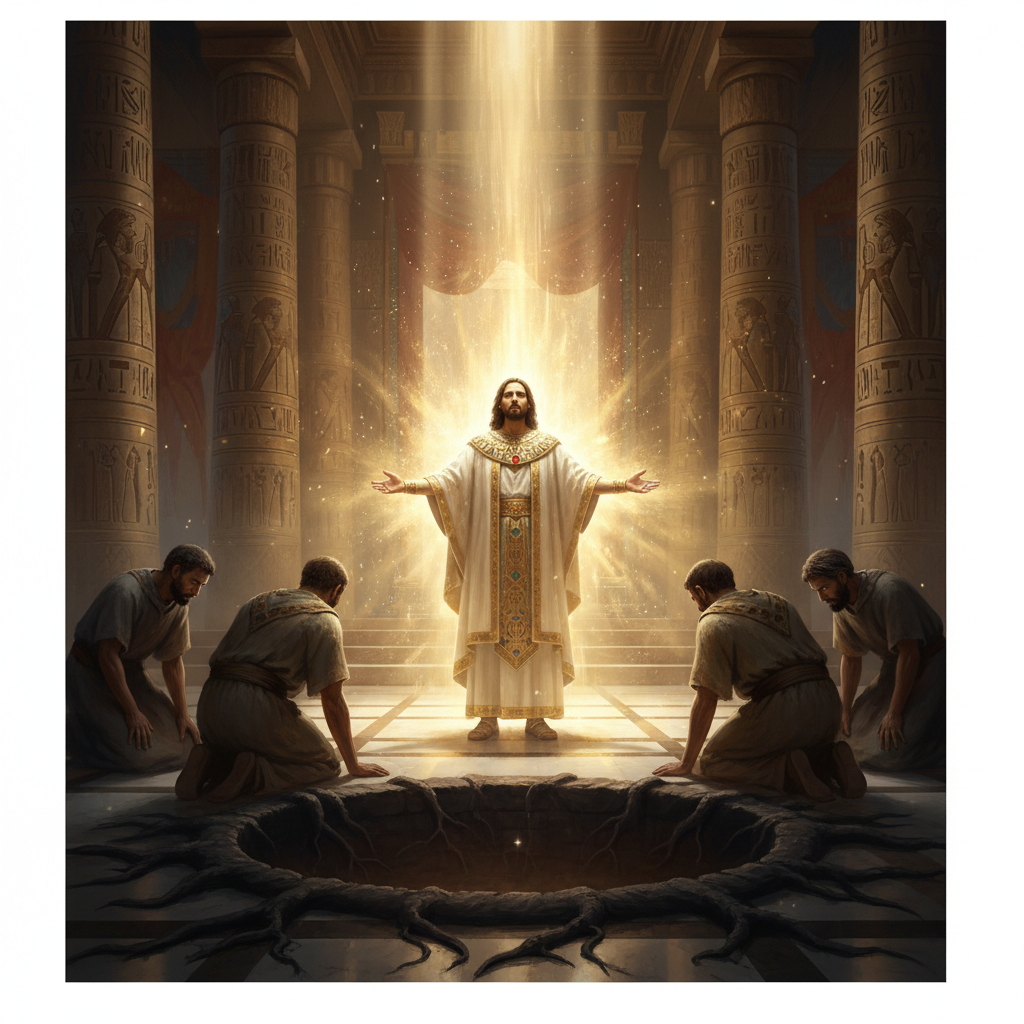
Joseph and the Secret of Forgiveness: Seeing the Hand of God Behind the Trial
The story of Joseph’s forgiveness is one of the Torah’s most profound teachings on the meaning of trials and Divine Providence.
Midrashic References
רַבּוֹת מַחֲשָׁבוֹת בְּלֶב אִישׁ וַעֲצַת ה’ הִיא תָקוּם (משלי יט, כא). הַשְּׁבָטִים חָשְׁבוּ לְהַעֲבִיר אֶת יוֹסֵף, וְהַקָּדוֹשׁ בָּרוּךְ הוּא חָשַׁב לַעֲשׂוֹתוֹ מֶלֶךְ, וְקָמָה עֲצַת ה’. (שמות רבה א:ד)
« There are many thoughts in a man’s heart, but it is the counsel of God that endures » (Proverbs 19:21). The brothers plotted to make Joseph disappear, but the Holy One, blessed be He, devised the plan to make him king, and it was the counsel of God that was fulfilled. (Shemot Rabbah 1:4)
אָמַר רַב יְהוּדָה בְּרַבִּי שָׁלוֹם: תִּרְאֶה כַּמָּה תַּחְבּוּלוֹת עוֹשֶׂה הַקָּדוֹשׁ בָּרוּךְ הוּא עַד שֶׁלֹּא יָבִיא אֶת הָאָדָם לִידֵי גְּדֻלָּה… (שמות רבה א:א)
Rabbi Yehuda bar Shalom said: See how many stratagems the Holy One, blessed be He, deploys before leading a man to greatness… The sale of Joseph by his brothers was the hidden divine instrument to ensure their survival and fulfill the heavenly plan. (Shemot Rabbah 1:1)
וַיְנַחֵם אוֹתָם וַיְדַבֵּר עַל לִבָּם (בראשית נ, כא). רַבִּי יוֹחָנָן אָמַר: שֶׁאָמַר לָהֶם דְּבָרִים שֶׁמִּתְקַבְּלִים עַל הַלֵּב, וְכִי עֲשָׂרָה נֵרוֹת לֹא יָכְלוּ לְכַבּוֹת נֵר אֶחָד, נֵר אֶחָד יָכוֹל לְכַבּוֹת עֲשָׂרָה נֵרוֹת? (בראשית רבה צד:ג)
« He comforted them and spoke to their hearts » (Genesis 50:21). Rabbi Yoḥanan taught: Joseph spoke reassuring words to them. He said to them: ‘If ten candles (you, the ten brothers) did not succeed in extinguishing one single candle (me), how could one single candle extinguish ten candles?’ (Bereishit Rabbah 94:3)
A modern story that reveals a spiritual principle
Imagine. It is November 2015, during the time of the knife attacks in Israel. A man, Daniel Cohen, is waiting for his bus. Suddenly, a searing pain. A knife has just been plunged into his back. Severely wounded, he is placed in a coma and rushed to the hospital. While operating on him, doctors discover the unthinkable: an extremely aggressive tumor that would have killed him within weeks. The knife wound, this act of pure hatred, had just saved his life.
This modern story, as incredible as it may be, is a reflection of a millenary wisdom taught by our Texts through biblical history. It invites us to look differently at the trials of our lives, a look like that of the patriarch Joseph: a look that sees beyond the fault.
The Paradox of Joseph’s Forgiveness
After years of suffering and separation, Joseph, having become vice-regent of Egypt, finds himself facing the brothers who sold him as a slave. Instead of vengeance, his words are disconcerting:
“And now, do not be distressed and do not be angry with yourselves for selling me here, because it was to save lives that God sent me ahead of you… So then, it was not you who sent me here, but God.” (Genesis 45:5-8)
Joseph seems to invent a new form of human relationship: he does not judge the intention, but the result. Since the final result is good, he erases the fault. But should we then congratulate Daniel Cohen’s attacker and award him a medal? Obviously not.
This attitude raises a staggering question: if everything comes from God, why punish? Why does justice exist? Joseph’s answer teaches us to navigate between two levels of reality: the human plane and the divine plane.
Seeing the hand of God in the trial
The Zohar, one of the fundamental texts of Kabbalah, explains that Joseph truly forgave. He erased the past because he saw the hand of God in all things. For him, evil is but an illusion, a step toward a greater good. In a world governed by Divine Providence (Hashgacha Pratit), what looks like a fall is often an elevation in disguise.
This unshakable faith is not an abstract theory. It is a lived force, even in the worst darkness. Recently, Julie Kuperstein, mother of a hostage in Gaza, received a call from a terrorist who wanted to threaten her. With impressive inner strength, she replied to him:
“My son is not in your hands. He is solely in the hands of the Creator. And so are you.”
The terrorist, taken aback, simply replied: “Respect, Madame.”
This response is the echo of Joseph’s. It does not deny the evil committed, but it refuses to give power to the perpetrator of evil. It affirms that the true master of the game is God. It is a message of Emunah (faith), of dignity and responsibility that invites us not to remain prisoners of fear.
Forgiving to free oneself from hatred
But forgiveness is not only an act of faith; it is also an act of protection.
A young couple gets married in Jerusalem in the middle of lockdown. The celebration is already reduced to a minimum when, following a malicious call, the police arrive and interrupt the ceremony. The joy is broken, the memory destroyed. Months later, on the eve of Yom Kippur, the man who had called the police contacts the groom, in tears. His life has been a disaster since that event and he begs for forgiveness.
After long hesitation, the husband decides to forgive. Not because the other deserves it, but because he wants to free himself from this weight. The next day, his pregnant wife is involved in a terrible car accident. He rushes to the hospital, expecting the worst. Miraculously, she and the baby are safe and sound. The doctors explain to him that if the airbag had deployed normally, it would have been fatal for them.
He then understands: his forgiveness was not a weakness. It was a shield. To forgive is to refuse to live as a prisoner of another’s hatred. It is an act that protects the one who forgives much more than the one who has sinned.
Human justice and Divine Providence
So, must we forgive everything and never defend ourselves? Absolutely not. The Torah establishes a fundamental distinction:
– Between man and his neighbor: what counts is the result. The harm caused must be repaired.
– Between man and God: what counts is the intention.
Joseph says to his brothers: on the human level, your action finally resulted in good, so I ask nothing of you. But on the spiritual level, your intention to harm remains your responsibility before Heaven.
Forgiveness does not mean denying evil or excusing the aggressor. King David, facing Shimei ben Gera who insulted him, accepted the humiliation as a divine message. But as king, he ensured that justice was served later to maintain order.
These two attitudes complement each other:
1. On the spiritual level: We welcome the trial as coming from God and we seek the hidden meaning, without nurturing hatred.
2. On the human level: We act concretely. We protect ourselves, we denounce injustice, and we ensure it is rectified.
From fault to reparation: the lesson of Joseph
Before revealing himself, Joseph puts his brothers to the test. Not out of vengeance, but to see if they have changed. He recreates the situation: another son of Rachel, Benjamin, is threatened. This time, Judah interposes, ready to sacrifice himself. At that moment, Joseph understands. His brothers were not evil, but immature, blinded by jealousy and fear.
He discovers that fault is often born from a wound, not fundamental cruelty. He then chooses reparation (Tikkun) rather than vengeance.
A final story to illustrate this principle. An elderly man used to violently drive away the Chabad emissaries who came every year to offer him to light the Hanukkah candles. One day, he welcomes them calmly and says: “Come in. I asked God for a sign, and a kippah fell from the sky in front of me.” What he didn’t know was that a neighbor had lost his kippah, carried away by the wind moments earlier.
An accident for one became a message for the other.
This is the whole story of Joseph. What seems to be an accident, a fall, an injustice, becomes an instrument of light. The real question is not: “Why is this happening to me?”, but: “What do I do now with what has happened to me?”
Joseph teaches us that we are not defined by our falls, but by our ability to rise and transform darkness into light. Even the most painful mistakes can become the roots of the greatest deliverance. It is a message of universal hope: even in the deepest night, the dawn is already on its way.
Deepen Your Midrash Studies
The richness of Jewish tradition lies within its ancient, millenary texts. To further explore the secrets of the Exodus and the fascinating narratives of our Sages, I invite you to discover my works.
-
-
Exclusive Translations: Explore Midrash Shemot Rabbah, faithfully translated into both English and French.
-
A Bridge Between Cultures: Commentaries crafted for Jewish, Christian, Muslim, and secular audiences alike.
👉 Browse the Midrashim.com Shop and Order My Books
-